
Can the UN still make peace?
With the Security Council divided and the UN’s wider credibility under strain, member states are looking to the next Secretary-General for a fresh vision of peacemaking. But what can one leader realistically do to restore the organization’s influence on peace and security?
Peace and security — Global
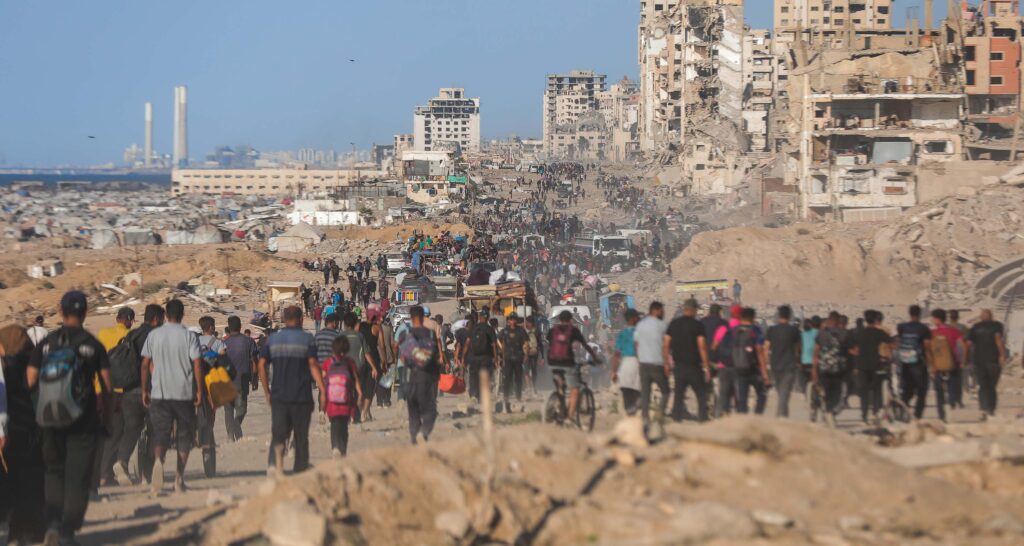

When US President Donald Trump visited the United Nations for the annual high-level meeting of the General Assembly in September 2025, he wrote off the UN as irrelevant to international peace and security. In the days that followed, my colleagues and I at the International Crisis Group had the opportunity to ask politicians and officials from around the world what they thought of the President’s views. Without exception, everyone agreed that the UN is failing to fulfill its primary Charter commitment to “save succeeding generations from the scourge of war.”
The need for the UN to regain credibility on peace and security is now feeding into discussions of who should replace António Guterres as UN Secretary-General in 2027. While Guterres has pioneered international cooperation on issues such as artificial intelligence, most UN members feel he has not invested enough energy in conflict prevention and resolution during his decade in office. His achievement in helping forge the Black Sea Grain Initiative in 2022, which reduced the impact of Russia’s all-out war on Ukraine on global food markets, stands out as his one major success as a mediator.
Diplomats and UN officials acknowledge that whoever follows Guterres will need to juggle issues ranging from climate change to the future of development. Most agree that he or she will need to offer a new vision of what the UN can contribute to peacemaking. That is not only because the world is a dangerous place, but also because a Secretary-General who carries weight on matters of peace and war is more likely to have influence on world leaders on other policy areas.
Why the UN looks weaker on war and peace
The UN’s position as a peace organization has looked increasingly precarious this year. The US has made a significant contribution to this downward cycle, both by ignoring the UN Charter in its attacks on Venezuela and Iran, and by floating President Trump’s Board of Peace – initially a UN-endorsed mechanism to oversee Gaza – as an alternative global peacemaking forum. In parallel, the Security Council and the General Assembly have been unable to make concrete efforts to end wars, from Sudan to Ukraine and Myanmar. Diplomats and international officials in New York are frankly despondent about the world organization’s ability to make or keep peace.
This is not because the UN has nothing to do. For all the talk of its decline, the UN oversees 60,000 peacekeepers and more than a dozen sanctions regimes worldwide. The Trump administration has also set aside its aversion to multilateralism to ask the UN for help stabilizing Haiti, where a new UN logistics mission will support anti-gang operations. Having slashed funding for relief efforts in war zones, Washington has also started to work more closely with the UN Office for the Coordination of Humanitarian Affairs, acknowledging that the UN aid system has unique operational strengths.
Yet despite these continuing areas of UN activity, it is hard to deny that the organization overall is adrift, and that its ability to shape major crises continues to slip. Few expect the Security Council – which has not launched a large-scale blue-helmet peace operation since 2014 and has been profoundly split over Ukraine and Gaza – to bounce back as a lively center of decision-making in the near future. At best, it may act as an institutional channel for China, Russia, and the US to work out solutions or ease disputes over crises where their interests converge. While there is no shortage of proposals for Council reform, the current veto powers seem happy with the status quo.
Other UN forums, such as the General Assembly, do speak out regularly on some crises, but they lack both the legal authority and political cohesion to replace the Security Council as a decision-making hub. The Assembly could do more to facilitate crisis diplomacy when the Council is stuck – for example, by endorsing mediators and international investigative mechanisms – but it does not have the powers to mandate sanctions or authorize the use of force that the Council enjoys.
Even without this sort of political top cover, the UN can help foster peace in individual trouble spots. The secretariat’s Peacebuilding Fund has a good reputation for supporting small projects on issues such as community reconciliation. But while this is important work, it is not on the sort of scale that seems necessary in an era of global crisis, when interstate wars and even major-power wars are increasingly real threats in many parts of the world. It is an open question whether the organization – which has seen its influence on peace and security wax and wane significantly over the decades – can stake out a credible case about why it matters in this troubled moment.
The evidence from recent UN reform efforts is mixed. In 2024, UN member states endorsed the Pact for the Future, a wide-ranging review of international cooperation, and restated their commitment to both the UN as a whole and specific tools like peace operations. But the UN80 reform process, launched by Secretary-General Guterres to streamline the organization in 2025 in response to US budget cuts, has generated very little new thinking on peace-related issues, other than tidying up a few institutional coordination issues. Senior officials from the organization’s peacekeeping and political affairs departments lobbied hard against major change.
A three-part agenda for the next UN chief
Given this shortfall, it is unsurprising that UN members are asking what the next Secretary-General can put forward on peace and security. This is in some ways unfair – it is a lot to ask one individual to reverse the overall decline of international cooperation. Nonetheless, the next UN chief could take at least three steps to show that the UN can still contribute to global stability.
The first is to re-establish the Secretary-General’s role as a top-level diplomatic broker, carrying messages quietly between powers and – where possible – stepping in to prevent and mediate conflicts. This means being willing to nurture relationships and take risks to bring rival powers together – and the potential for failure is always high. But previous Secretaries-General, going back to Dag Hammarskjöld and U Thant, did manage to play this role in periods of global tension.
The second step is to empower the UN secretariat to put more ideas on the table for solving conflicts, even though – as with personal diplomacy – a lot of initiatives will fail. UN officials say that the organization has become very conservative in response to recent geopolitical friction, and Security Council members complain that the quality of advice they receive from the UN system is often poor. The next Secretary-General will need to encourage international officials to table plans for dealing with specific conflicts that show the UN can bring fresh ideas to the table.
The third step the next Secretary-General must take is to craft a compelling pitch to global public opinion about why the UN’s peace and security efforts matter. The organization’s peacemaking work currently attracts little international attention. But in an era when people in many countries are increasingly nervous about the risks of conflict, there is still room to make the case for the UN and international cooperation.
No Secretary-General can revive the UN’s fortunes as a peacemaking institution alone. States that want to see multilateralism, including small and middle powers, will need to offer their collective backing for the next UN chief’s efforts. But the alternative – effectively admitting that the UN is no longer a player in international peace and security – risks weakening the institution and accepting that the international laws and rules the UN represents can no longer hold anarchy at bay.
Featured in:
UNGA 2026 edition: Looking for leadership
As the established global powers have retreated from development, no one has stepped up to fill their place: not the Global South, not the middle powers, not a loosely assembled BRICS. The agenda that has guided development since 2015 is losing the cohesion it once had, just as the political appetite for it fades.
Yet across this edition, practitioners keep building a coherent, evidence-based case for a fairer, safer, sustainable world. Their work supplies the thought leadership that politics has not – and it will provide the framework for success when real political will returns.
Authors include Adriana E. Abdenur, Bineta Diop, Richard Gowan, Phoebe Koundouri, Emi Minghui Gui, Chidi King, María Fernanda Espinosa Garcés, Tobias Schillings and Rachel Marcus.
Publication date: 15 September 2026
Related articles
A global digital commons for SDG delivery
The SDGs do not lack science, legitimacy, or vision – they lack an operating system. A global digital commons can help countries move from reporting progress to delivering transformation by bringing together open data, integrated modeling, stakeholder co-design, and sustainable finance
Empowering women during humanitarian crises
As conflicts grow more protracted, climate shocks intensify, and aid budgets shrink, gender equality cannot be treated as optional. Women’s leadership and rights must be central to effective humanitarian action