
Valuing urban resilience
Cities face difficult choices about how to invest in resilience as climate
pressures intensify. Valuing health, ecosystems, social inclusion, and reliable services alongside financial costs can help them choose fairer, more effective ways to adapt to climate change
Cities — Europe, Global
Authors

Phoebe Koundouri
Professor, Athens University of Economics and Business and University of Cambridge; Co-Chair, UN Global Sustainable Development Report 2027; Founder and Director, AE4RIA Research Centers

Conrad Landis
Assistant Professor, Department of Economics, University of Ioannina; Researcher, ReSEES.AE4RIA, Athens University of Economics and Business; SDU.AE4RIA, ATHENA Research Center; UN SDSN Global Climate Hub
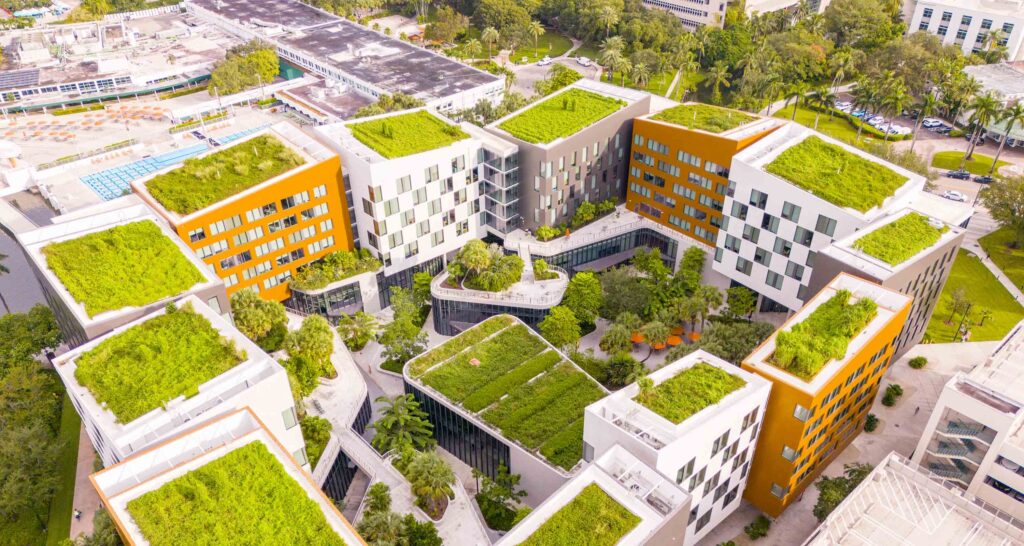
Cities are where climate risks and development choices collide. Heatwaves raise electricity demand and threaten health. Drought strains water and food systems. Floods damage transport, housing, and utilities. And poorly planned infrastructure can lock in emissions and vulnerability. Green roofs, water reuse, rainwater harvesting, cooling systems, and desalination therefore cannot be judged only by construction costs. They also affect public health, ecosystems, social inclusion, energy use, and the reliability of essential services.
Urban adaptation consequently sits at the intersection of Sustainable Development Goals (SDGs) 3 (health and well-being), 6 (water and sanitation), 7 (affordable and clean energy), 9 (infrastructure), 11 (sustainable cities), and 13 (climate action), with further consequences for inequality, biodiversity, and decent work.
Traditional financial appraisal captures capital expenditure (CAPEX) and operating expenditure (OPEX) but often overlooks benefits that have no market price. A wetland may reduce flood peaks, filter pollutants, and support biodiversity. Urban trees may cool streets, improve air quality, and create recreational value. A local wastewater reuse scheme may strengthen water security and reduce pressure on centralized networks. Social cost-benefit analysis broadens the decision frame by asking whether the total benefits to society exceed the total costs, regardless of who pays or whether the benefit is traded in a market.
Valuing what markets overlook
The analysis combines market and non-market values to calculate an intervention’s total social net present value. The market component calculates the present-day value of capital and operating costs, revenues, and avoided expenditures over the life of the intervention. The non-market component covers services such as water regulation, habitat support, health, and quality of life. An intervention’s description is compared with four broad categories of ecosystem service – provisioning, regulating, supporting, and cultural – to identify which services it is most likely to provide. Benefit-transfer calculations draw on a screened database of 5,486 environmental valuation studies and are adjusted to regional conditions before aggregation and discounting.
The method uses data from primary valuation studies to construct a prediction equation. This relates reported household willingness to pay to the type of ecosystem service, the regional climate and ecology, the valuation method, and socio-economic characteristics. Characteristics of the target area are then entered into the model to estimate a per-household value. The resulting estimate is weighted by the intervention’s service profile, multiplied by the number of affected households, and converted into a present-day value over the life of the intervention. The approach follows Johnston et al in Benefit Transfer of Environmental and Resource Values (2015), together with subsequent applications by Koundouri et al in Valuation of marine ecosystems and Sustainable Development Goals (2023) and Ecosystem services valuation for supporting sustainable life below water (2023).
TABLE 1: What a social cost-benefit appraisal counts
| DIMENSION | WHAT ENTERS THE APPRAISAL | WHY IT MATTERS FOR URBAN RESILIENCE |
| Market investment | CAPEX, annual OPEX, revenues, and avoided expenditures, discounted over time. | Tests affordability, budget pressure, and long-term operating needs. |
| Non-market value | Household willingness to pay for ecosystem services, scaled to affected households, and socially discounted. | Makes health, water regulation, biodiversity, and amenity benefits visible. |
| Regional context | Regional climate and ecology, household numbers, and socio-economic characteristics. | Shows where benefits occur and which communities are affected. |
| Implementation risk | Governance, finance, inequality, acceptance, skills, infrastructure, technology, coordination, engagement, and climate uncertainty. | Distinguishes theoretical value from what can be delivered in practice. |
Benefit transfer makes hidden value visible but does not remove judgment. Estimates can be misleading when local incomes, ecosystems, cultural preferences, or project design differ from the original studies. Willingness to pay also reflects ability to pay, so lower-income communities should not appear less important because their monetary responses are smaller.
The choice of discount rate matters too when converting future costs and benefits into present-day values: a high fixed rate favors near-term savings, while a social discount rate that declines over time gives greater weight to benefits for future generations. Social cost-benefit analysis should therefore remain a screening and comparison tool, supported by local ecological evidence, distributional analysis, and stakeholder deliberation, rather than an automatic decision rule.
Testing the approach in practice
The methodology and case evidence were developed through the IMPETUS project, an EU Horizon 2020 initiative that brought together 32 partners from nine countries and tested adaptation approaches across seven European regions with different climates and ecosystems. Within the project, the Athens University of Economics and Business team combined social cost-benefit analysis with a risk-factor assessment covering governance, finance, inequality, social acceptance, technical expertise, infrastructure, technology access, inter-sectoral coordination, stakeholder engagement, and climate uncertainty. The result is a portfolio view: an intervention can produce high social value yet still fail if institutions, finance, or public trust are weak.
The IMPETUS case study in Attica, Greece, shows the value of assessing adaptation measures in this broader way. The region faces heat, drought, groundwater pressure, competing urban, agricultural, and tourism demands, and rising energy use. Stakeholders assessed a range of measures to address water scarcity and strengthen climate resilience, including information campaigns and policy measures, two phases of treated-wastewater reuse, rainwater harvesting at two scales, controlled-environment agriculture, desalination, and sewer mining (the extraction of wastewater from the sewer network for local treatment and reuse). The screening results below compare investment inputs with relative ratings for intangible benefits and cost-effectiveness.
Table 2: illustrative results for the Attica water-scarcity portfolio
| INTERVENTION | CAPEX (€m) | ANNUAL OPEX (€m) | INTANGIBLE BENEFIT RATING | COST EFFECTIVENESS RATING |
| Information campaigns and policy | 0 | 5.00 | 4 | 3 |
| Treated-wastewater reuse: phase 1 | 57 | 3.50 | 4 | 2 |
| Treated-wastewater reuse: phase 2 | 32 | 1.90 | 4 | 4 |
| Rainwater harvesting: 5,000 homes | 8.7 | 0 | 2 | 8 |
| Controlled-environment agriculture | 22 | 0 | 4 | 7 |
| Rainwater harvesting: 15,000 homes | 26 | 0 | 2 | 6 |
| Desalination | 72 | 21.90 | 1 | 1 |
| Sewer mining | 5 | 0.14 | 4 | 5 |
Note: CAPEX and OPEX are in millions of euros. Ratings are relative to this eight-intervention portfolio. Higher values indicate stronger performance in that dimension.
Rainwater harvesting for 5,000 homes was the most cost-effective option, despite a lower intangible benefit rating. Controlled-environment agriculture also performed strongly on cost-effectiveness while offering benefits through water efficiency and more stable food production. Sewer mining occupied a useful middle position: it combined substantial non-market benefits with moderate cost-effectiveness, while also diversifying the local water supply.
Information and policy measures delivered broad societal benefits with no initial capital cost, although their annual program cost and dependence on sustained behavioral change limited their relative efficiency. Treated-wastewater reuse generated strong environmental benefits, but the first phase was less cost-effective because of infrastructure costs. The second phase improved as scale and system use increased.
Desalination ranked last on both dimensions. It can provide a dependable water source when rainfall is unreliable, but the assessed option required €72 million in CAPEX and annual OPEX of €21.9 million, alongside high energy demand and environmental concerns. Renewable electricity can lower its carbon footprint, but it does not remove the high capital cost, the need to dispose of brine, or other operational trade-offs. This highlights why water, energy, and infrastructure decisions must be considered together: decarbonizing energy can improve an adaptation option without automatically making it the best overall investment.
Results from the IMPETUS case study in the Dutch province of Zeeland show the same need for a portfolio approach. Cooling technologies and energy-efficient appliances received the highest intangible benefit ratings, while early-warning systems were the most cost-effective. Green roofs, vegetated areas, shading, and replacing hard surfaces with green space delivered moderate ecosystem-service ratings and generally low operating costs, but their relative efficiency varied with scale and design. Public-health measures were inexpensive and fast to deploy, even where the broad ecosystem-service classification assigned them lower scores for intangible benefits. That apparent tension is useful: it shows why screening results must be interpreted alongside local health data and the needs of vulnerable residents.
Building a balanced resilience portfolio
Cities should therefore avoid choosing between green and gray infrastructure as if they were mutually exclusive. Nature-based solutions can cool neighborhoods, retain stormwater, and improve biodiversity, but they require land, maintenance, and long-term governance. Engineered assets can provide more predictable service levels, but they often involve higher financial costs and energy demand and can lock cities into inflexible systems. Behavioral measures and early-warning systems can be highly cost-effective, yet they depend on trust and institutional capacity.
The strongest strategy is usually a sequenced portfolio:
- low-cost preparedness and demand management first
- targeted nature-based and efficiency measures next
- capital-intensive supply or protective infrastructure only for risks that remain after other measures are in place
Combining measures in this way can also turn connections between the SDGs into practical action. Water reuse links SDG 6 to resilient infrastructure under SDG 9 and sustainable cities under SDG 11. Efficient cooling and building measures connect SDGs 7 and 13 while protecting health under SDG 3. Green infrastructure can support biodiversity and reduce unequal exposure to heat and flooding – but only if its benefits reach disadvantaged neighborhoods. Finance should follow this integrated logic: budgets and investment plans should recognize avoided losses, ecosystem services, and social co-benefits, not only direct cash flows.
This work forms part of a wider program of research by AE4RIA and the ReSEES Laboratory at Athens University of Economics and Business. ReSEES’s work includes environmental valuation, econometrics, integrated environmental-economic modeling, risk analysis, geographical information systems, and the development of decision-support tools. Related AE4RIA projects cover:
- climate neutrality and resilience
- sustainable oceans and seas
- the interconnections between water, food, energy, and biodiversity
- innovation acceleration
- socio-economic and financial pathways
- education and skills
Together, these projects support the development and application of transferable appraisal methods.
What cities count as value
Urban resilience will depend not only on how much cities invest, but on what they count as value. Social cost-benefit analysis cannot settle every ethical or political question, and the uncertainty in its estimates must be made clear. Yet it can reveal benefits that conventional accounts ignore, show where energy, water, and infrastructure choices reinforce or undermine one another, and help decision-makers set priorities more credibly.
Used with local evidence, stakeholder co-design, and implementation-risk analysis, it offers cities a practical way to select a mix of measures that is financially responsible, socially just, and ecologically durable.

Related articles

A global digital commons for SDG delivery
The SDGs do not lack science, legitimacy, or vision – they lack an operating system. A global digital commons can help countries move from reporting progress to delivering transformation by bringing together open data, integrated modeling, stakeholder co-design, and sustainable finance

Employment that empowers women
Work can liberate women and transform societies, but employment alone is not enough. As digital, green, and demographic transitions reshape labor markets, the challenge is to ensure that every woman has access to decent work, rights, security, and opportunity