
A global digital commons for SDG delivery
The SDGs do not lack science, legitimacy, or vision – they lack an operating system. A global digital commons can help countries move from reporting progress to delivering transformation by bringing together open data, integrated modeling, stakeholder co-design, and sustainable finance
Climate — Global
Authors

Phoebe Koundouri
Professor, Athens University of Economics and Business and University of Cambridge; Co-Chair, UN Global Sustainable Development Report 2027; Founder and Director, AE4RIA Research Centers
Angelos Alamanos
Independent Researcher

Conrad Landis
Assistant Professor, Department of Economics, University of Ioannina; Researcher, ReSEES.AE4RIA, Athens University of Economics and Business; SDU.AE4RIA, ATHENA Research Center; UN SDSN Global Climate Hub

Anna Triantafyllidou
Researcher, ReSEES.AE4RIA, Athens University of Economics and Business; SDU.AE4RIA, ATHENA Research Center; UN SDSN Global Climate Hub
Ioannis Arampatzidis
Researcher, ReSEES.AE4RIA, Athens University of Economics and Business; SDU.AE4RIA, ATHENA Research Center; UN SDSN Global Climate Hub
The world is not short of sustainability knowledge. But it is short of the operational infrastructure needed to use that knowledge at the speed and scale the Sustainable Development Goals (SDGs) require. Climate shocks now interact with food and energy insecurity. Debt stress limits investment in adaptation. Wars and geopolitical instability weaken cooperation. Biodiversity loss, health risks, technological disruption, and widening inequalities interact in ways that no single ministry, sector, or dataset can fully capture.
This article draws on our academic working paper, A Global Commons Framework for Systems Transformation toward the SDGs, which argues that the SDG implementation gap is, at its core, an operational gap. The missing piece is not another conceptual map of where the world should go, but a practical way to connect systemic evidence, social legitimacy, and finance so that countries can act.
The delivery gap: we know what to transform, but not how to deliver it
The 2030 Agenda remains the most comprehensive global framework for linking climate stability, economic resilience, human well-being, social justice, and institutional cooperation. Yet implementation remains far behind what is needed. Almost all countries have committed to the 2030 Agenda, and most have submitted voluntary national reviews, but global progress is still too slow, and many indicators are moving in the wrong direction.
Over the past decade, influential frameworks have helped organize what needs to change. The “six transformations” proposed by Sachs and others in 2019 grouped SDG delivery around major shifts in:
- education and inequality
- health and well-being
- energy decarbonization and sustainable industry
- sustainable food, land, water, and oceans
- sustainable cities
- the digital revolution
The 2023 Global Sustainable Development Report built on this logic by identifying entry points for transformation and levers such as:
- governance
- economy and finance
- science and technology
- capacity building
- individual and collective action
These frameworks are essential. They move policy beyond isolated SDG targets and help decision-makers see that transformation must cut across sectors. But they can also become less useful when treated as fixed categories to be applied everywhere in the same way. Countries differ radically in ecological constraints, fiscal space, institutional capacity, energy systems, food systems, water risks, trade exposure, and social vulnerabilities.
This is why entry points and levers should not be prescribed in advance. They should emerge from measurement, modeling, and stakeholder engagement grounded in each country’s ecological, economic, and social constraints. Before deciding which lever to pull, governments need to understand the system they are trying to transform.
A digital global commons in practice
A digital global commons can provide this missing operating layer: an open-access infrastructure of data, models, scenario tools, valuation methods, participatory processes, and financing intelligence that enables governments, researchers, communities, and investors to design country-specific sustainability pathways.
The Sustainable Development Solutions Network (SDSN) Global Climate Hub (GCH), anchored within the AE4RIA-SDSN network, offers a concrete example of this approach. It brings together AI-ready data, connected models of sectors such as energy, transport, and land use, and digital twins – virtual representations of real-world systems that allow researchers and policymakers to test different scenarios. Combined with stakeholder co-design, open-science tools, and capacity building, these resources help turn sustainability goals into practical pathways at national, regional, and global levels.
This matters because sustainability choices are never isolated. Renewable energy deployment affects land use. Land use affects food security, biodiversity, and water demand. Water stress affects productivity, health, infrastructure resilience, and investment risk. Climate adaptation depends on fiscal capacity. Social acceptance depends on whether households, workers, firms, and regions experience the transition as fair.
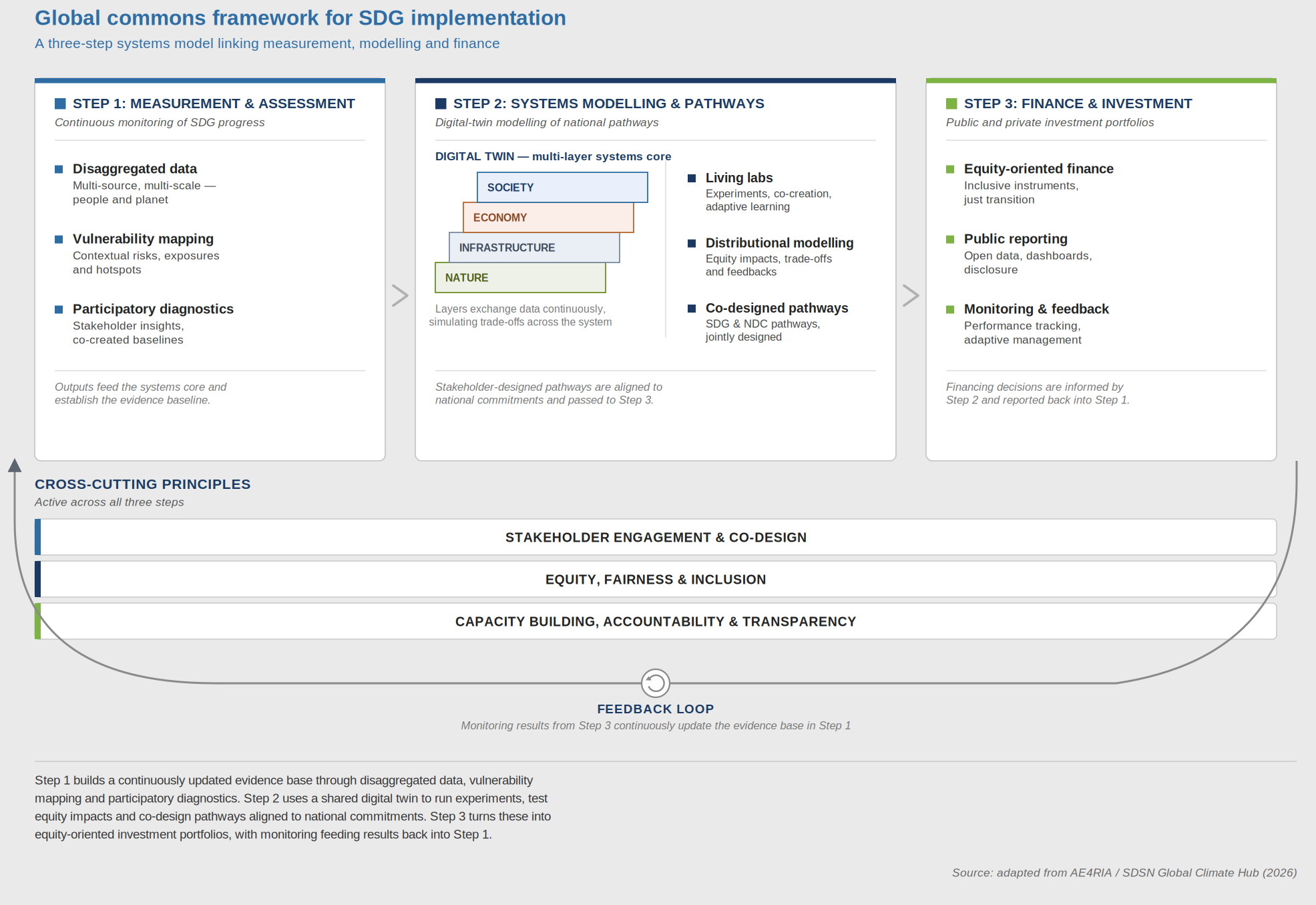
As set out in our working paper, we have developed a three-step framework for translating this systemic logic into practical action.
Figure 1: the proposed AE4RIA-SDSN global commons framework for sustainability transformations
Source: Koundouri P, Alamanos A, and Landis C, 2026. “A Global Commons Framework for Systems Transformation toward the SDGs: Operationalizing pathways through coupling data infrastructures, integrated modelling, co-design, and sustainable financing,” DEOS Working Papers 2613, Athens University of Economics and Business.
A three-step approach to turning sustainability goals into action
First, countries need to monitor and assess progress continuously. This means combining administrative data, remote sensing, socio-economic statistics, infrastructure inventories, and local knowledge to establish baselines that policymakers can use. The output should not be another static report. It should take the form of interactive dashboards, hotspot maps, risk matrices, and digital twins that show where intervention is most urgent and where existing commitments are off track.
Second, countries need to develop transformation pathways that are grounded in science and co-designed with stakeholders. Integrated modeling can show how energy, water, land, food, transport, health, and macroeconomic systems interact, revealing where policies create synergies and where they involve trade-offs. But models are only useful if their assumptions are credible and their findings are clear. Living labs – collaborative, real-world settings in which researchers, policymakers, businesses, and communities co-design and test solutions – can bring local knowledge, distributional concerns, and implementation constraints into the modeling process from the outset.
The AE4RIA Living Labs network puts this engagement into practice, supported by the Living Lab Modeler, an online tool for planning, managing, assessing, and sharing the outcomes of living lab activities. This matters because co-design is not a communications exercise conducted after a model has been built. It should shape the objectives, constraints, scenarios, and implementation pathways from the beginning.
Third, countries need financing pathways and investment portfolios that are directly linked to the scientific evidence and co-design process. The global financial system still channels too little capital toward long-term sustainable development, especially in low and middle-income countries. Development investments often require horizons of 20 to 40 years, but many countries face short loan maturities, high borrowing costs, and debt sustainability rules that can discourage productive investment.
Financing is therefore critical. Without it, integrated modeling risks producing elegant pathways that remain unfunded. With it, governments and their partners can compare grants, concessional loans, guarantees, blended finance, private-sector participation, and user charges in terms of affordability, fiscal effects, distributional consequences, and economic performance. Governments can then use the co-designed pathways to assess gaps in their nationally determined contributions, prepare adaptation investment plans and budget stress tests, and develop pipelines of bankable projects.
Why decision-making must value more than GDP
A major weakness of conventional decision-making is that many of the benefits of sustainable development are undervalued. Cleaner air, flood protection, urban cooling, biodiversity, water quality, public health, ecosystem resilience, and cultural value often fall outside narrow economic assessments. When these benefits remain invisible, countries underinvest in the assets that sustain long-term prosperity.
Our proposed global commons framework therefore integrates ecosystem-service assessment and “beyond GDP” valuation into the modeling process, enabling progress to be assessed in ways that capture social and environmental value as well as economic output. This changes how different pathways are evaluated. Instead of ranking options solely by their costs or effects on GDP, decision-makers can compare their wider contributions to well-being, resilience, natural capital, distributional fairness, and intergenerational equity.
For SDG delivery, this is not an academic refinement – it is a political and financial necessity. When nature-based solutions, resilience investments, or pollution reductions are not valued properly, they appear less attractive than they really are. Measuring their benefits transparently can support stronger public investment, better regulation, green bonds, sustainability-linked finance, and more credible just transition packages.
The public interest challenge: digital tools must be governed as public goods
There is a legitimate concern that digital sustainability infrastructure could reinforce inequality if it becomes proprietary, opaque, or accessible only to institutions with advanced technical capacity. Models can also create false confidence when they obscure uncertainty, the choices built into them – such as which data, methods, and scenarios to use – or their distributional effects. AI can accelerate analysis, but it can also reproduce bias when data quality and governance are weak.
This is why the “commons” in a digital global commons is not decorative – it is foundational. Open methods, transparent modeling choices, shared datasets, public reporting, stakeholder review, accessible training, and accountability mechanisms are essential. The aim is not to centralize authority in a technical platform. It is to democratize access to the tools needed for informed decision-making.
Capacity building must therefore be part of the infrastructure itself. Countries and communities need open-access training programs, policy labs, and local technical partnerships so that they can use, challenge, adapt, and improve the tools themselves. A global commons framework should not export answers. It should strengthen the capacity of people in each context to develop their own.
The way forward: from SDG reporting to SDG delivery
The SDG agenda does not need another conceptual map as much as it needs a delivery system. Reporting progress is necessary, but insufficient. Countries need adaptive pathways that can be monitored, revised, financed, and implemented under uncertainty.
A digital global commons offers one practical route forward by connecting measurement to modeling, modeling to participation, participation to finance, and finance back to accountability. It can reveal where action is urgent, where trade-offs are unavoidable, where co-benefits can help build coalitions, and where investment can deliver the greatest social, economic, and environmental return.
The SDGs remain the right vision. But vision alone will not deliver transformation. The world now needs the operational infrastructure to act on that vision: open data, integrated models, stakeholder co-design, beyond-GDP valuation, and financing pathways that turn ambition into implementation. The choice is whether we build the tools needed to navigate complexity intelligently or continue improvising with instruments designed for a simpler world. The first option is still within reach. The cost of the second is one no generation should have to bear.
Featured in:
UNGA 2026 edition: Looking for leadership
As the established global powers have retreated from development, no one has stepped up to fill their place: not the Global South, not the middle powers, not a loosely assembled BRICS. The agenda that has guided development since 2015 is losing the cohesion it once had, just as the political appetite for it fades.
Yet across this edition, practitioners keep building a coherent, evidence-based case for a fairer, safer, sustainable world. Their work supplies the thought leadership that politics has not – and it will provide the framework for success when real political will returns.
Authors include Adriana E. Abdenur, Bineta Diop, Richard Gowan, Phoebe Koundouri, Emi Minghui Gui, Chidi King, María Fernanda Espinosa Garcés, Tobias Schillings and Rachel Marcus.
Publication date: 15 September 2026
Related articles
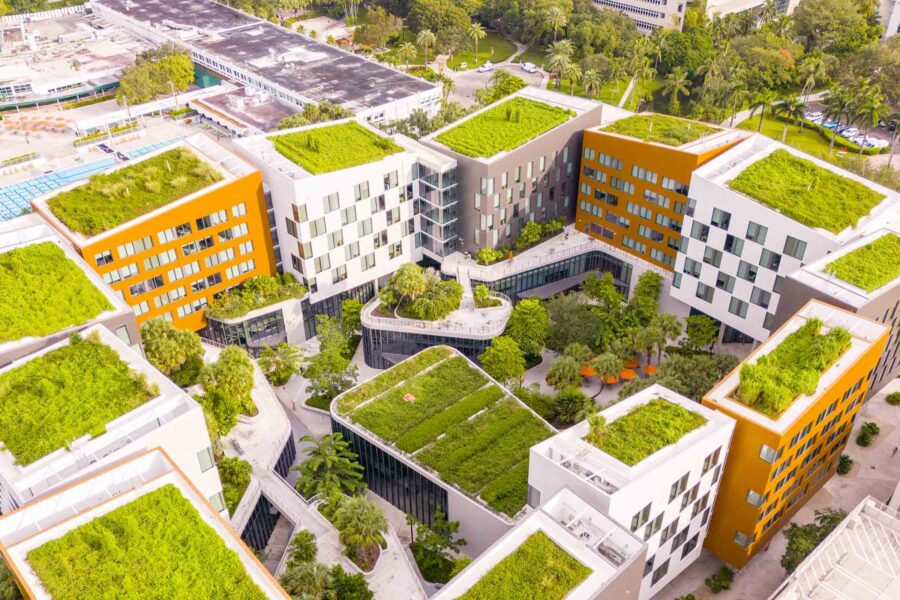
Valuing urban resilience
Cities face difficult choices about how to invest in resilience as climate
pressures intensify. Valuing health, ecosystems, social inclusion, and reliable services alongside financial costs can help them choose fairer, more effective ways to adapt to climate change
Employment that empowers women
Work can liberate women and transform societies, but employment alone is not enough. As digital, green, and demographic transitions reshape labor markets, the challenge is to ensure that every woman has access to decent work, rights, security, and opportunity