
The hidden toll of maternal malnutrition in conflict settings
Conflict and displacement are driving a largely overlooked crisis in maternal nutrition, with grave consequences for women, babies, and long-term development. Protecting mothers’ health is one of the most effective ways to save lives and advance progress across the SDGs in fragile settings
Gender — Global, Sub-Saharan Africa
Authors

Geraldine Anup‑Willcocks
International Board Certified Lactation Consultant and Principal Humanitarian Adviser at UNICEF UK

Óscar Serrano Oria
Senior Nutrition and Early Childhood Development Programs Adviser, UNICEF UK
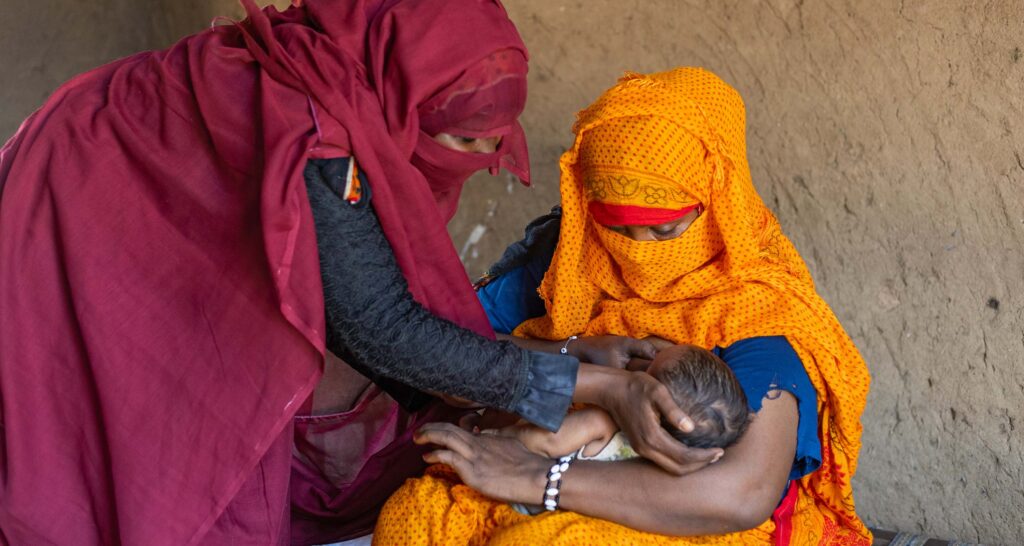
A mother gazes down at her tiny baby girl – barely the size of a standard bag of sugar. Her baby is too weak to respond, too weak to feed. This longed-for baby was born too early to breastfeed effectively, and too early to survive without support, because her mother has been so poorly nourished herself. This young mother doesn’t have the health support she might have had at home – she’s been displaced by conflict, and is far from her livelihood, support system, and the midwife who supported her at home. If this tiny baby does survive, the impact of her mother’s malnutrition will affect her mind and body for her entire life, limiting her ability to thrive.
This is a scene that happens far too often. At least 1 in 10 babies worldwide is born too early, with maternal malnutrition among the factors that can increase the risk of preterm birth. This leaves newborns weak, vulnerable to disease, and at risk of interrupted breastfeeding. These risks are intensified by myths that lead mothers to stop nursing even when they can safely continue, such as the belief that stress or poor diet will degrade the quality of their breastmilk. Adolescent mothers face a much higher risk of preterm birth due to physical and emotional immaturity, with around 21 million adolescent pregnancies occurring each year in low and middle income countries. This is particularly common in emergencies, where families may resort to harmful coping strategies like child marriage.
How conflict turns malnutrition into a cycle of harm
Anyone who has had a child will relate to the strong urge to build a secure nest in which to nurture their children. But for over 60 million forcibly displaced women and girls, conflict uproots them from their homes and livelihoods, disrupting access to nutritious food, clean water, and essential healthcare. They are driven to temporary camps and settlements where nutritious food is scarce, clean water is unavailable, and healthcare is absent.
This can set off a dangerous chain reaction. The mother becomes malnourished, restricting her unborn child’s growth. Her baby is born prematurely, meaning she needs skilled infant feeding support to produce enough milk, but this is rarely available in displacement settings. The combined stress of her circumstances and the difficulties of feeding her baby slow the flow of her milk, as cortisol inhibits the hormones that help it flow freely. And so, she begins to believe that her supply is insufficient and starts to introduce formula, which she will often have to mix with unsafe water. Her baby then loses the critical protective factors and unequalled nutrition her milk provides.Premature babies are highly vulnerable to malnutrition in emergencies, with an up to 20-fold higher risk of death compared to normal-weight infants.
If this baby survives this hard start in life, the impact of early malnutrition is irreversible, affecting both the baby’s physical and mental development. According to UNICEF, about half of children under two who are stunted become so during pregnancy and the first six months of life. And so, the cycle continues: these malnourished babies are at far greater risk of complications during birth, weakened immunity, poor cognitive development – and poorer outcomes for growth, learning, and earning later in life. This is a stark example of how closely linked the Sustainable Development Goals (SDGs) are: failure to achieve SDG 2 on ending hunger undermines SDG 3 on good health, which in turn affects SDGs 4, 5, and 8, as malnutrition limits a child’s ability to learn, thrive, and eventually secure decent work.
Maternal malnutrition is most severe in sub‑Saharan Africa and South Asia, where conflict and climate shocks are driving acute food insecurity for millions. In conflict‑affected countries such as Afghanistan, Chad, Ethiopia, Nigeria, Somalia, South Sudan, Sudan, and Yemen, acute malnutrition among pregnant and breastfeeding women has risen by 25% since 2020, according to UNICEF’s Undernourished and overlooked report. Maternal mortality risks are as extreme as 1 in 134 in Chad, compared to 1 in 12500 in the UK according to the World Bank. Of the worst affected countries, the funding outlook is bleak, and the situation is rapidly deteriorating. Many of the worst affected countries receive very little media attention, and recent international aid budget cuts have led to around 14 million children facing disruptions to nutrition support. The Standing Together for Nutrition Consortium warn of 369,000 additional child deaths each year and severe threats to maternal survival, with countries like Somalia seeing large numbers of health and nutrition facilities closing down as a result . It’s still unclear how deep the aid cuts will be finally, but if current patterns continue, they will fall disproportionately on services for mothers and children, including nutrition.
What must be done
Even within this depressing context, many of those lives can be saved if we focus our resources on the elements that can have a catalytic effect on maternal and child health.
Unlike other areas of humanitarian aid, maternal nutrition and care are quiet but enabling forms of humanitarian work. Everything a baby needs is within the body of her mother – but in conflict settings, investment is required to prevent disruption of this perfect natural system. Though arguably the most impactful interventions, these are not the visible, noisy forms of humanitarian work that we see in television adverts, and so their life-changing impacts are often overlooked. If humanitarian funding can focus resources on the following interventions, we can prevent the cascade of events that so often ensues from maternal malnutrition:
- Skilled healthcare workers deployed to establish an antenatal and postnatal care service network focused on increasing coverage rapidly and providing the minimum package of visits.
- Multiple micronutrient supplementation made available as early in the pregnancy as possible, with a focus on ensuring continued access even when populations are displaced.
- Nutrition counselling packages that can be adapted to realistically include locally available and affordable foods to improve maternal health, along with skilled breastfeeding counselling. These are often best implemented through creating dedicated, safe, welcoming spaces for mothers to gather, feed their babies, and access support.
- Priority for pregnant and lactating women in targeted cash transfer programs, so that women are not forced to choose between their own nutrition and that of their families.
By focusing our resources on maternal nutrition, we can help break this chain reaction for girls and women in these underreported crises, reducing the number of premature births. Babies will be born stronger and more resilient, better able to breastfeed without intensive feeding support. There will be less need to mix formula with unsafe water or to depend on donated formula. Breastfeeding will help protect the children of displaced mothers, who often face poor nutrition and a lack of access to clean, safe water. Through their mothers’ milk, these children also benefit from antibodies that help protect them against diseases such as diarrhea and pneumonia, which remain leading causes of death in children under five in these settings.
Because when we protect maternal nutrition, we do more than prevent immediate harm – we can change the course of a woman’s life, and of the lives that depend on her.
Featured in:
UNGA 2026 edition: Looking for leadership
As the established global powers have retreated from development, no one has stepped up to fill their place: not the Global South, not the middle powers, not a loosely assembled BRICS. The agenda that has guided development since 2015 is losing the cohesion it once had, just as the political appetite for it fades.
Yet across this edition, practitioners keep building a coherent, evidence-based case for a fairer, safer, sustainable world. Their work supplies the thought leadership that politics has not – and it will provide the framework for success when real political will returns.
Authors include Adriana E. Abdenur, Bineta Diop, Richard Gowan, Phoebe Koundouri, Emi Minghui Gui, Chidi King, María Fernanda Espinosa Garcés, Tobias Schillings and Rachel Marcus.
Publication date: 15 September 2026
Related articles
Employment that empowers women
Work can liberate women and transform societies, but employment alone is not enough. As digital, green, and demographic transitions reshape labor markets, the challenge is to ensure that every woman has access to decent work, rights, security, and opportunity
Investing to avert a sanitation crisis
Demographics and climate change are combining to create an impending sanitation crisis in many poorer regions of the world. Averting it means investing now in safe, climate-resilient sanitation as a foundation for health, dignity, and prosperity