
Women, climate change, and the search for accountability
As climate litigation gathers force, women are helping to redefine what accountability looks like – and exposing how far climate policy still is from delivering gender justice
Gender — Global
Authors

Brianna Howell
Research Analyst, UN Women

Laura Turquet
Policy Advisor and Deputy Chief, Research and Data team, UN Women
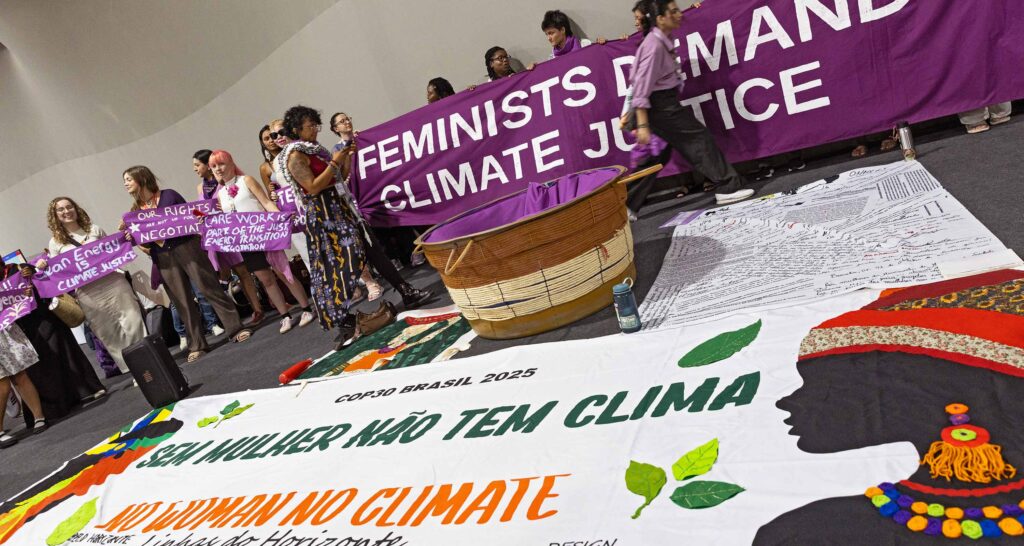
When you consider women’s access to justice, you most likely think of the quest for accountability for gender-based violence, workplace equality, or land rights – all essential for advancing gender equality. But legal strategies are also increasingly being used to catalyze bolder and faster government action to address the climate crisis. In 2024, more than 2,000 older Swiss women won a landmark case at the European Court of Human Rights, which found that their government’s inadequate climate action violated their human rights. Young, indigenous, and rural women also shaped the July 2025 ruling of the Inter-American Court of Human Rights, which required governments to ensure that gender and other intersectional forms of discrimination are taken into account in climate policies.
These cases are part of a growing wave of climate litigation – one that recently reached the International Court of Justice (ICJ), the world’s highest court. In July 2025, it delivered what many climate advocates had been waiting for: a clear, unanimous ruling that states are legally obligated under international human rights law and climate treaties to address the climate crisis and its deadly impacts.
This bottom-up effort was spearheaded by law students in Fiji – a nation that contributes less than 1% of global emissions yet faces existential threats from the climate crisis. Another Pacific nation, Vanuatu, championed the case, bringing it to the UN General Assembly, which voted, with the support of 105 countries, to request an advisory opinion from the ICJ. This was the most participatory case in the ICJ’s history, with countries and international organizations submitting nearly 200 written and oral statements combined.
The decision paves the way for people, groups, and states to seek accountability for climate harm. It determined that nations’ failure to meet their commitments constitutes a wrongful act that must be stopped, remedied, and prevented from recurring. This could include reparations from the largest greenhouse gas emitters, historically concentrated in the Global North.
The question now is how to translate this decision into justice for those who have suffered most – and what it will take to ensure their claims succeed.
As climate risks rise, policy lags
There’s a reason why women and girls have been turning to the courts for justice. A growing body of evidence shows that women and girls, particularly those in the Global South, are facing the worst impacts of climate change. The Intergovernmental Panel on Climate Change (IPCC), in chapter 18 of its Sixth Assessment Report, highlights these gendered impacts. By 2050, under a worst-case climate scenario, more than 158 million additional women and girls could be pushed into extreme poverty, nearly half of them in Africa, and 236 million more could face food insecurity, according to UN Women’s gender snapshot 2025 report.
These patterns are not random. Globally, discriminatory laws, policies, and social norms restrict women’s equal access to rights and resources, including employment, land ownership, credit, technology, and justice. As a result, when climate disasters strike and disrupt livelihoods, infrastructure, and public services, women are less able to adapt, recover, and seek redress for the harm they suffer. These cascading impacts also put the Sustainable Development Goals – particularly those on gender equality, poverty, hunger, health, and climate action – further out of reach.
What, then, are countries doing to address the twin challenges of gender inequality and the climate crisis, and to meet their obligations under international law? The ICJ advisory opinion affirmed that climate action must be gender-responsive – in other words, it must meet the needs and rights of women and girls. In a major step forward, most countries’ latest climate plans – known as nationally determined contributions, or NDCs – recognize the harsh impacts of climate change on women and girls.
This is one of the main findings of the Gender equality and climate policy scorecard, launched by UN Women and the Kaschak Institute. The scorecard tracks gender equality commitments in climate policy and gives advocates the data they need to drive change. But recognizing these unequal impacts is only the first step. The scorecard therefore identifies six essential areas for action:
- women’s economic security
- unpaid care work
- health
- gender-based violence
- leadership and participation
- gender mainstreaming
Economic security is the most frequently addressed dimension, with most countries making commitments in areas such as green jobs, climate finance, and climate-resilient agriculture. But other critical areas remain neglected. Climate change intensifies women’s unpaid care burdens, from fetching water and cooking to caring for sick family members. The risk of gender-based violence also rises: after years of progress, child marriage is increasing in places under climate stress. Yet fewer than half of countries commit to action on women’s health or unpaid care, and only a handful commit to address gender-based violence as part of their climate plans.
From legal victory to real change
The gap between how climate change affects women and what governments are committing to do is stark. Yet the scorecard reveals innovative policy examples in every region. Closing these gaps depends on three critical factors.
First, supporting women’s meaningful participation in planning, monitoring, and decision-making at every level – from local to international. Too often, women on the frontlines of protecting people and ecosystems from environmental destruction are criminalized and attacked. Impunity for this violence must end, so that women-led and grassroots organizations can take their rightful place at the table where climate solutions are designed.
Second, investing in more and better data is essential. Better data can help us see and address inequalities, strengthen the evidence base for legal and political claims, and monitor the implementation of climate commitments. This will help identify what is working, reveal shortcomings, and strengthen accountability for government inaction.
Third, ensuring women’s participation and their continued leadership of climate solutions depends on their access to climate finance – and this is where the ICJ’s recognition of reparations becomes most consequential. Unlike overseas development aid or voluntary contributions, reparations are grounded in responsibility. The ICJ’s ruling that the largest historic emitters have caused demonstrable harm, and have an obligation to repair it, creates a legal and moral basis for shifting climate finance from charity to responsibility. This means ensuring dedicated and predictable funding that reaches the countries, communities, and women on the frontlines of a crisis they did little to create.
The ICJ has given gender equality and climate advocates a powerful new lever for justice. Whether it delivers will depend on governments, courts, and institutions placing those most affected – rural women, indigenous communities, and young people in the most impacted nations – at the center of what comes next.
Featured in:
UNGA 2026 edition: Looking for leadership
As the established global powers have retreated from development, no one has stepped up to fill their place: not the Global South, not the middle powers, not a loosely assembled BRICS. The agenda that has guided development since 2015 is losing the cohesion it once had, just as the political appetite for it fades.
Yet across this edition, practitioners keep building a coherent, evidence-based case for a fairer, safer, sustainable world. Their work supplies the thought leadership that politics has not – and it will provide the framework for success when real political will returns.
Authors include Adriana E. Abdenur, Bineta Diop, Richard Gowan, Phoebe Koundouri, Emi Minghui Gui, Chidi King, María Fernanda Espinosa Garcés, Tobias Schillings and Rachel Marcus.
Publication date: 15 September 2026
Related articles

Valuing urban resilience
Cities face difficult choices about how to invest in resilience as climate
pressures intensify. Valuing health, ecosystems, social inclusion, and reliable services alongside financial costs can help them choose fairer, more effective ways to adapt to climate change
A global digital commons for SDG delivery
The SDGs do not lack science, legitimacy, or vision – they lack an operating system. A global digital commons can help countries move from reporting progress to delivering transformation by bringing together open data, integrated modeling, stakeholder co-design, and sustainable finance