
When work separates mothers and babies, everyone pays the price
Mothers are encouraged to breastfeed, yet too often expected to do so within work systems built around separation. If we want to improve breastfeeding rates, those systems must change – through stronger legislation on workplace responsibilities, flexible working, and care arrangements that allow mothers and babies to stay together
Gender — Global
Author

Geraldine Anup‑Willcocks
International Board Certified Lactation Consultant and Principal Humanitarian Adviser at UNICEF UK
(This article uses the terms “mothers” and “breastfeeding” for clarity, reflecting common usage, but recognises that parents define their identities and caregiving in diverse ways. While not all parents are able or choose to breastfeed, enabling responsive caregiving – including supporting closeness between caregivers and infants – is essential for all children’s wellbeing, and experiences of separation can vary widely.)
In a tribal village in India my colleague rushed to the school door, smoothed her sari, and gently passed her baby to the school cook, who settled at the back of the classroom with wooden blocks. She strode to the front. The children stood to greet her in unison, ready for maths.
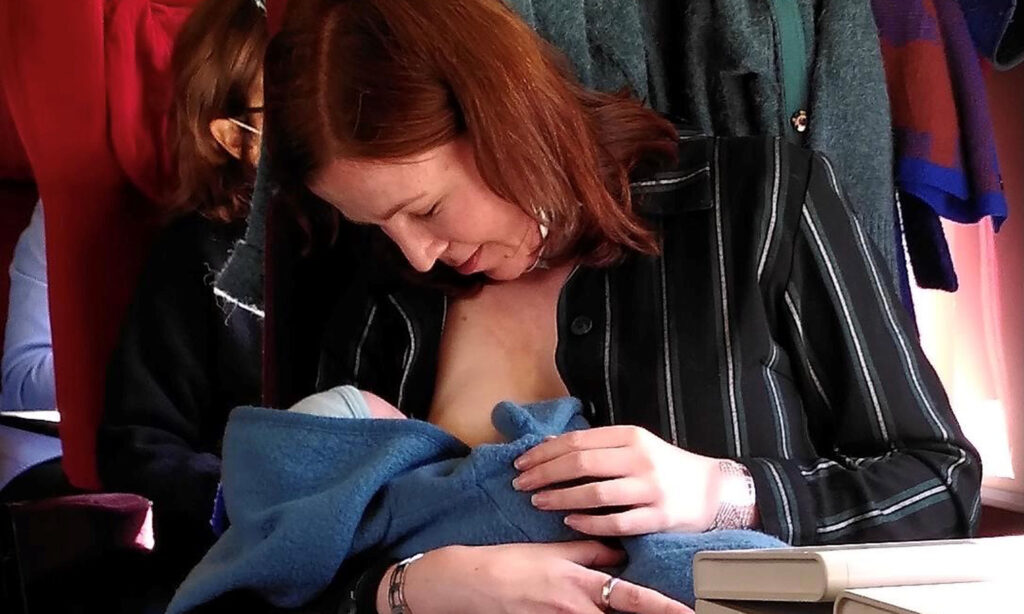
Across the world, the picture often looks very different. A mother stands on a train, pulled further away from the baby her body and mind are wired to stay close to. She worries through the day – will he take her expressed milk? What will this separation mean for him? Breastfeeding is far more than milk – it is comfort, regulation, immunity and bond. Yet, as workplaces demand presence, it is treated as something that can be scheduled, replaced, or quietly dropped.
Why breastfeeding support matters
For centuries in societies like Britain, separating mothers and babies was not an accident – it was designed. From wet-nursing and industrialisation that pushed women and children apart for economic survival, through to aggressive marketing of breastmilk substitutes and pumps, each era reinforced the idea that maternal care could be outsourced.
Today, that legacy persists in modern work structures that promote breastfeeding in theory but make proximity between mothers and babies almost impossible in practice.
At each stage, the message has shifted – but the outcome has stayed the same: mothers and babies are expected to adapt to separation, rather than work adapting to support the closeness that babies need.
But we know more now. Science has shown the critical role of responsive nurturing in the early years for both mother and child. Yet we continue to ignore it.
Breastfeeding provides superior nutrition, adapting with every feed to the nutritional and immunological requirements of a child. It helps protect against a range of illnesses, including the leading causes of death in children under five. For mothers, the postnatal period also carries significant mental health risks: the World Health Organization (WHO) estimates that around one in eight women who have recently given birth experience a mental disorder, primarily depression, with higher rates in developing countries. Yet breastfeeding is one of the most protective factors.
The WHO reports that breast cancer remains the most common cancer among women worldwide and the second most common cancer overall. Yet each year a mother breastfeeds, her risk of developing invasive breast cancer is reduced by 6 percent. Breastfeeding may also support craniofacial development, protecting children from ear and breathing disorders and dental problems.
The impact on physical health is profound: increasing breastfeeding rates to near universal levels could prevent 823,000 deaths in children under five and 20,000 maternal deaths each year.
The mental health implications are also important. In the context of a global children’s mental health crisis, where one in seven children is affected, responsive caregiving shapes the brain and regulates stress responses. Prolonged separation can activate infants’ stress systems, and has been linked to poorer emotional, cognitive, and behavioral outcomes later in life. Instinctively, most mothers feel this when they return to work away from their child – and we ignore this at our peril.
Anthropological research suggests that, from an evolutionary perspective, the natural weaning age for humans may be between two-and-a-half and seven years. WHO recommends breastfeeding up to two years of age or beyond, with breastmilk continuing to provide up to a third of a child’s nutritional needs in the second year of life, alongside immunological and developmental benefits. It’s therefore critical that mothers are still able to breastfeed and nurture their children after the first year of life to ensure every child’s right to the best possible health (Article 24 of the UN Convention on the Rights of the Child). A mother is biologically primed to care for her young – her body produces milk to nurture and protect her child, and her presence is not something that can simply be substituted with a nursery and a pump.
The gap between policy and practice
So, are we making this possible? In the UK, 74.2% of mothers with children aged 14 or under are in employment, and many other countries are seeing a similar pattern. Yet only around 1% of babies in the UK are exclusively breastfed at six months as per recommendations – meaning they receive only breastmilk, with no formula, water or solids – and at 12 months breastfeeding becomes exceptionally rare. WHO highlights a lack of supportive environments – particularly in the workplace – as an important driver of this decline.
As a lactation consultant, I am often asked by conflicted mothers facing difficult choices about stopping or reducing breastfeeding while their babies are still very young. I see families encouraged to rely on pumping as a substitute for breastfeeding, which can increase stress for the dyad and commonly leads to problems such as mastitis, child illness, and early weaning. I hear about breastfeeding rooms designed for pumping, but not for feeding babies directly. In practice, going to work often means separation, reduced or stopped breastfeeding, and pressure on families to adapt to existing systems rather than systems adapting to babies’ needs.
In many countries, return-to-office policies are adding pressure, with women often disproportionately affected. Mothers of young children are the hardest hit, and breastfeeding mothers are being asked to spend long hours away from their child while managing the consequences alone.
What this reveals is a deeper issue: our systems are designed to help mothers manage separation, rather than to avoid it in the first place.
The current push for return to office working is intensifying this pressure. Widely acknowledged to affect women disproportionately, it places the greatest burden on mothers of young and breastfeeding children – who are expected to absorb the consequences alone.
Yet separation is rarely as inevitable as we assume. In Rwanda, UNICEF offices include spaces where babies can remain close, with carers supporting mothers between feeds. In South Sudan, babies stay with their mothers as they work in hospital compounds. At the United Nations General Assembly, Jacinda Ardern brought her baby in a sling; in the Australian parliament, Larissa Waters breastfed while speaking.
These are not anomalies of biology – but examples of different choices in system design.
Babies’ needs do not change from one workplace or country to another. The difference is that some systems have normalized mother-baby separation. If women work, young children will need care – but the assumption that work and proximity cannot coexist is a cultural and policy choice, not a biological inevitability.
Many governments have committed to improving breastfeeding rates and upholding children’s right to health. But current systems place responsibility on the individual. Legal protections focus on preventing discrimination, not enabling breastfeeding, and there is often no requirement to support proximity between mothers and babies. Asking a mother to prioritise breastfeeding without allowing her to be with her child is like asking a plant to thrive while removing it from sunlight.
What needs to change
There is a clear structural solution – and one that would support several Sustainable Development Goals (SDGs). Laws and workplace policies must place responsibility on employers to enable breastfeeding, rather than leaving mothers to justify their children’s biological needs. To genuinely promote and protect breastfeeding, we need to move away from models that normalize separation and instead support proximity between mothers and children.
If children are to realize their right to the best possible health, workplaces, governments, and societies must use their resources to help mothers combine paid work with responsive care. This means focusing on three core areas:
1. Redesign work to keep mothers and babies close
Workplaces must shift from assuming separation to enabling proximity wherever possible. This includes flexible and remote work, job-sharing, adjusted schedules, and, where needed, on-site or near-site childcare to support responsive feeding.
This would support SDG 5 on gender equality, SDG 8 on decent work and economic growth, and SDG 3 on good health and well-being.
2. Make workplace support a legal duty
Governments should go beyond non-discrimination and introduce clear legal obligations on employers to support continued breastfeeding. This includes:
- the right to flexible and remote work for mothers during early childhood
- requirements to enable breastfeeding (not just expressing)
- protection from unnecessary separation
Investing in breastfeeding support is not a cost—it is a high‑return economic intervention. It reduces employer costs through improved retention and productivity, while globally, inadequate breastfeeding is already driving over US$340 billion in avoidable healthcare costs and lost economic output each year.
For policymakers, the choice is stark: in the context of ageing populations and declining birth rates, investing in early childhood and maternal support is not optional—it is a foundational strategy to sustain health systems, protect human capital, and secure long‑term economic resilience.
This would support SDG 3 and SDG 10 on reduced inequalities.
3. Treat breastfeeding as a systems issue
Health systems, employers, and policymakers must stop placing responsibility on mothers alone. Healthcare professionals and global actors, including the UN, WHO, and UNICEF, should explicitly advocate for structural change, including workplace reform and social protection.
This would support SDG 2 on zero hunger, SDG 3, and SDG 5.
A system that works for mothers and children
If we want to improve breastfeeding rates globally, we must stop asking mothers to adapt to systems that were never designed for them – and start reshaping those systems around the needs of mothers and children.
At the end of the day, my colleague collected her sleeping baby from the school cook, tucked him into her sari, and walked home – having spent the day both teaching and nurturing.
That should not feel exceptional.
It should feel possible.
Because every mother should be able to work without being forced into an unnecessary choice – and every child deserves to grow in the closeness they need to thrive.
Featured in:
UNGA 2026 edition: Looking for leadership
As the established global powers have retreated from development, no one has stepped up to fill their place: not the Global South, not the middle powers, not a loosely assembled BRICS. The agenda that has guided development since 2015 is losing the cohesion it once had, just as the political appetite for it fades.
Yet across this edition, practitioners keep building a coherent, evidence-based case for a fairer, safer, sustainable world. Their work supplies the thought leadership that politics has not – and it will provide the framework for success when real political will returns.
Authors include Adriana E. Abdenur, Bineta Diop, Richard Gowan, Phoebe Koundouri, Emi Minghui Gui, Chidi King, María Fernanda Espinosa Garcés, Tobias Schillings and Rachel Marcus.
Publication date: 15 September 2026
Related articles

Employment that empowers women
Work can liberate women and transform societies, but employment alone is not enough. As digital, green, and demographic transitions reshape labor markets, the challenge is to ensure that every woman has access to decent work, rights, security, and opportunity