
Delivering urban water under uncertainty
Safe, affordable water in urban areas is central to sustainable development, yet progress remains uneven. To close this gap, cities need to adopt integrated, evidence-based approaches that build resilient and equitable services in practice
Cities — Europe, Global
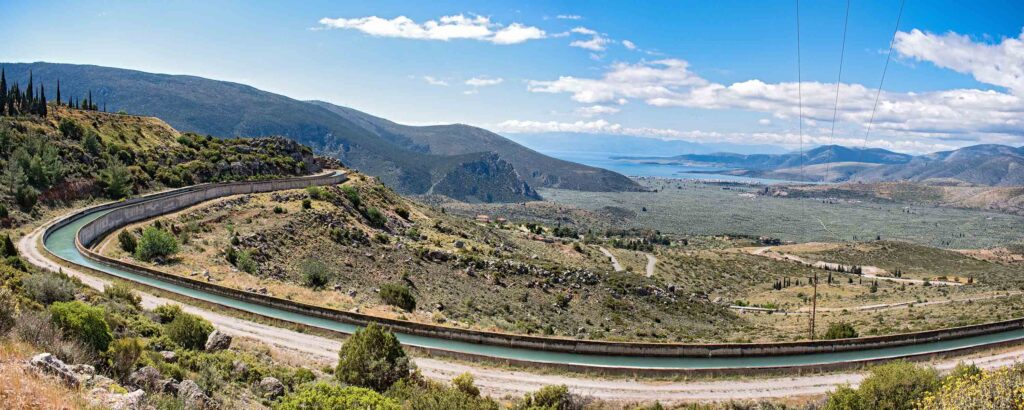
Authors

Phoebe Koundouri
Professor, Athens University of Economics and Business and University of Cambridge; Co-Chair, UN Global Sustainable Development Report 2027; Founder and Director, AE4RIA Research Centers

Angelos Alamanos
Independent Researcher

Anna Triantafyllidou
Researcher, ReSEES.AE4RIA, Athens University of Economics and Business; SDU.AE4RIA, ATHENA Research Center; UN SDSN Global Climate Hub

Ioannis Arampatzidis
Researcher, ReSEES.AE4RIA, Athens University of Economics and Business; SDU.AE4RIA, ATHENA Research Center; UN SDSN Global Climate Hub
Urban water systems are no longer “just” utilities. They are socio-technical infrastructures operating under high uncertainty: climate volatility, changing consumption patterns, ageing networks, pollution risks, and competing uses across water, energy, and food systems (often referred to as the water–energy–food nexus). A city can meet a technical supply target and still fail the public if affordability collapses, service reliability becomes unequal, or trust erodes. That is the pathway to political backlash and underinvestment – precisely the conditions that lock cities into fragility.
Urban water stress is a systems problem
Across Europe’s Southeast Mediterranean – and increasingly beyond – water stress is being driven by the layering of:
- climatic aridification and higher evaporation
- rapid urban expansion and seasonal tourism peaks
- pollution and water-quality degradation
- chronic underinvestment that has left treatment, metering, and distribution networks outdated
These pressures are compounded by entrenched inequities: low-income and peri-urban groups are often more exposed to service unreliability and contamination risks and have fewer options to adapt.
Policy frameworks already exist. For example, Europe has long embraced holistic principles through instruments such as the EU Water Framework Directive and the Urban Waste Water Treatment Directive. But implementation remains uneven, held back by local obstacles, underfunding, and weak integration between pricing, investment planning, and social protection.
This matters because water reliability is a foundation for socio-economic stability in cities. When water policy is reduced to isolated technical upgrades or tariff reforms, it misses the reality that renewables, land-use change, wastewater reuse, network losses, and household vulnerability are part of the same system. In practice, siloed decisions can produce “optimal” plans that fail under prolonged or repeated droughts, peak demand, affordability constraints, or public rejection.
The operating system cities need to deliver reliable water
Most cities already agree on the vision: resilient, efficient, safe, and affordable drinking-water services, compatible with environmental limits. The gap is not ambition, but delivery capability under uncertainty.
What is missing is an integrated operating system that can:
- quantify trade-offs and synergies across hydrology, infrastructure, demand, energy, finance, and equity
- stress-test decisions under a range of climate and socio-economic futures rather than single forecasts
- embed legitimacy through co-design, so reforms are not only “efficient” but feasible in practice
- iterate continuously, updating models and policies as new evidence arrives (from sensors, pilots, and behavioral responses)
The Water-Futures project, funded by the European Research Council, is one attempt to build such an operating system in practice. The project integrates cross-sectoral modeling, digital-twin forecasting (using virtual replicas of physical systems), and real-time monitoring with socio-economic and behavioral approaches, deploying these through Living Labs that act as regulated sandboxes for testing reforms and technologies.
The evidence loop: a practical route forward
Building on this operating-system approach, the Sustainable Development Solutions Network’s Global Climate Hub proposes an integrated framework for sustainable urban water services, centered on a structured “evidence loop.”
1. Cross-sectoral modeling of physical and natural systems
Combine hydrology and water-resource availability with drinking-water system modeling (supply, treatment, storage, distribution, and losses). This includes scenario analysis that explicitly considers uncertainty and – where feasible – digital twins that ingest real-time data.
2. Socio-economic modeling of vulnerability, affordability, and pricing
Treat tariffs and investments as tools that shape who pays and who benefits, not just revenue tools. Integrate vulnerability mapping, affordability constraints, and welfare impacts to make “full cost recovery” compatible with social foundations.
3. Experimental and behavioral economics to reveal acceptance and response
Use stated preference or choice experiments (survey-based methods to understand how people value different options) to estimate willingness-to-pay, preferences for investment bundles (for example, leak detection, nature-based solutions, or reuse), and behavioral responses to tariff structures and messaging (including loss-aversion framing).
4. Living Labs for co-creation, validation, and iteration
Implement pilots and policy tests in real settings, using workshops, randomized trials where appropriate, and regulated sandboxes. Feed observed behavioral uptake, performance metrics, and distributional outcomes back into the models, continuously recalibrating both the technical and the socio-economic assumptions.
Closing the loop
The core principle is simple:
- models generate hypotheses
- valuation and distributional analysis assign social meaning
- Living Labs test feasibility and legitimacy
- results feed back to update both models and policy design
Athens in practice: a blueprint for urban water delivery
In Athens (a large European urban water system serving roughly 4.4 million people), Water-Futures applies this integrated philosophy to design “learning” drinking-water networks – systems that can adapt to unanticipated conditions through explainable machine learning, continuous monitoring, and scenario-based decision support.
The project explicitly reframes the urban water network as an asset for societal well-being (not only an engineering artifact). It operationalizes the socio-technical transformation via the “experimental economics and Living Lab loop.”
Within this approach, Living Labs combine:
- physical pilots (such as smart metering, Internet of Things leak detection, decentralized treatment, and nature-based interventions), connected to a secure data backbone
- digital-twin scenario exploration, integrating meteorological, demand, hydraulic, and socio-economic data to stress-test decisions and create shared “objects of negotiation” for stakeholders
Critically, this structure makes contested policy variables testable:
- urban growth and peak demand can be represented and trialed
- climate shocks are modeled across a range of scenarios (droughts, extremes, or groundwater impacts)
- economic constraints are explored through tariffs, subsidies, or financing instruments
- social justice is quantified through sampling and distributional metrics that reveal who bears costs and who benefits
A city’s water transition fails when it produces either technically elegant plans without public acceptance, or politically acceptable plans that violate hydrological and infrastructure limits.
The “modelling, valuation, and Living Lab loop” is designed to avoid both failure modes by producing:
- distributional metrics and socio-economic narratives that support equitable tariff design (including lifeline tiers and targeted subsidies), grounded in affordability constraints and measured preferences rather than assumption
- robust investment packages that are “scalable because validated”: leak reduction, monitoring, AI forecasting, decentralized treatment and reuse options, and nature-based solutions – selected not only for technical performance but also for legitimacy and ease of implementation
- transparent decision support: open data protocols, clear impact metrics, and mandatory validation through modeling, economic analysis, and Living Lab testing before major infrastructure or tariff reforms – so decisions are defensible and trusted
From pilots to scale
There are three clear priorities for sustainable cities and urban water infrastructure:
1. Reframe water security as reliable service and social legitimacy
Reliability is not only continuity of supply – it is also water quality, affordability, and perceived fairness. Cities should institutionalize distributional assessment as part of routine utility decision-making, so that equity becomes a design constraint rather than an afterthought.
2. Move from isolated projects to integrated, uncertainty-ready pathways
Cities need integrated pathways that link hydrology, networks, demand management, pollution control, and investment sequencing – stress-tested under a range of futures. The objective is robustness: decisions that perform well across plausible climates and socio-economic trajectories, not only under a “most likely” forecast.
3. Institutionalize Living Labs as regulated sandboxes for tariffs, nudges, and technology
Public acceptance is not a communications problem; it is a design problem. Living Labs allow tariff reforms, behavioral interventions, and technology pilots to be tested transparently, iterated quickly, and scaled only after validation – linking innovation pipelines to utilities through matched funding and open evaluation criteria.
From framework to delivery at scale
Cities can secure reliable, high-quality drinking-water services – even under deep uncertainty. But this will not be achieved through narrow technical upgrades or tariff debates in isolation. The Athens Water-Futures example, aligned with the Global Climate Hub’s approach, illustrates a replicable blueprint: combine cross-sectoral physical modeling and digital-twin tools with socio-economic analysis of vulnerability and pricing, then validate reforms through Living Labs that function as sandboxes for generating evidence and building legitimacy.
The vision of sustainable cities is clear. What is needed now is the operational infrastructure to deliver it: integrated models, transparent distributional metrics, iterative experimentation, and co-designed pathways that respect both hydrological limits and the social contract.
Featured in:
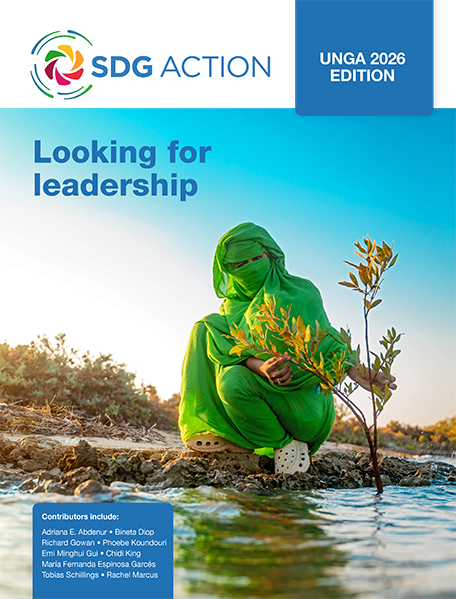
UNGA 2026 edition: Looking for leadership
As the established global powers have retreated from development, no one has stepped up to fill their place: not the Global South, not the middle powers, not a loosely assembled BRICS. The agenda that has guided development since 2015 is losing the cohesion it once had, just as the political appetite for it fades.
Yet across this edition, practitioners keep building a coherent, evidence-based case for a fairer, safer, sustainable world. Their work supplies the thought leadership that politics has not – and it will provide the framework for success when real political will returns.
Authors include Adriana E. Abdenur, Bineta Diop, Richard Gowan, Phoebe Koundouri, Emi Minghui Gui, Chidi King, María Fernanda Espinosa Garcés, Tobias Schillings and Rachel Marcus.
Publication date: 15 September 2026

Related articles
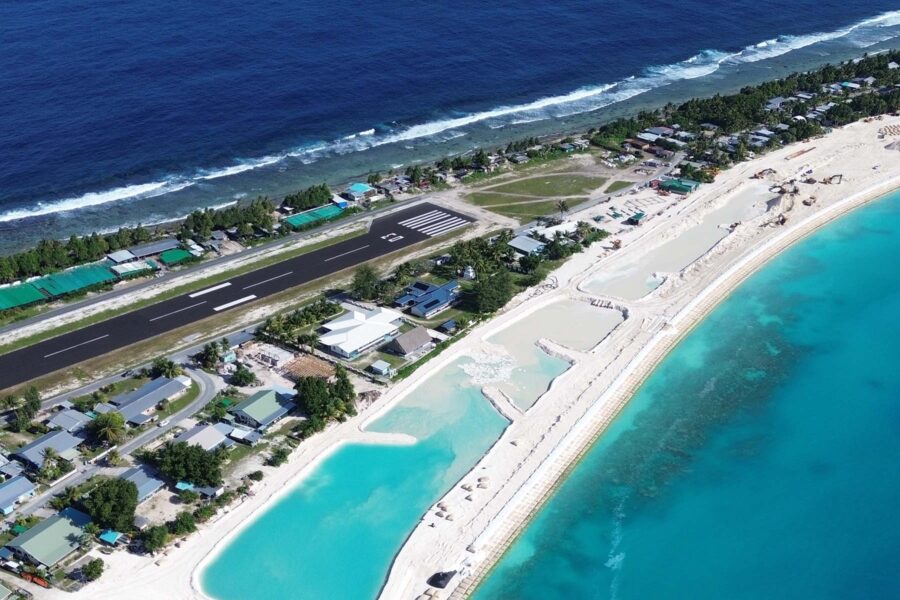
Stop treating finance as the last step in adaptation
Too often, adaptation finance is treated as an exercise that begins only once a plan is finished. Building investment planning into resilience strategies from the start is key to turning plans on paper into bankable projects on the ground

In the Sahel, peace starts with water
A shrinking Lake Chad and increasingly erratic rains are pushing herders and farmers in the Sahel into conflict over water and land. Lasting peace depends on securing indigenous land rights, strengthening cross-border cooperation, and putting climate finance directly in local hands
Global urban goals: who asked the planners?
SDG 11, the New Urban Agenda and the International Guidelines on Urban and Territorial Planning all rely on planners to put them into practice. Yet no one has conducted a representative survey of planners, asking whether these frameworks have changed their work, or whether the planning laws they work under even allow what the frameworks call for