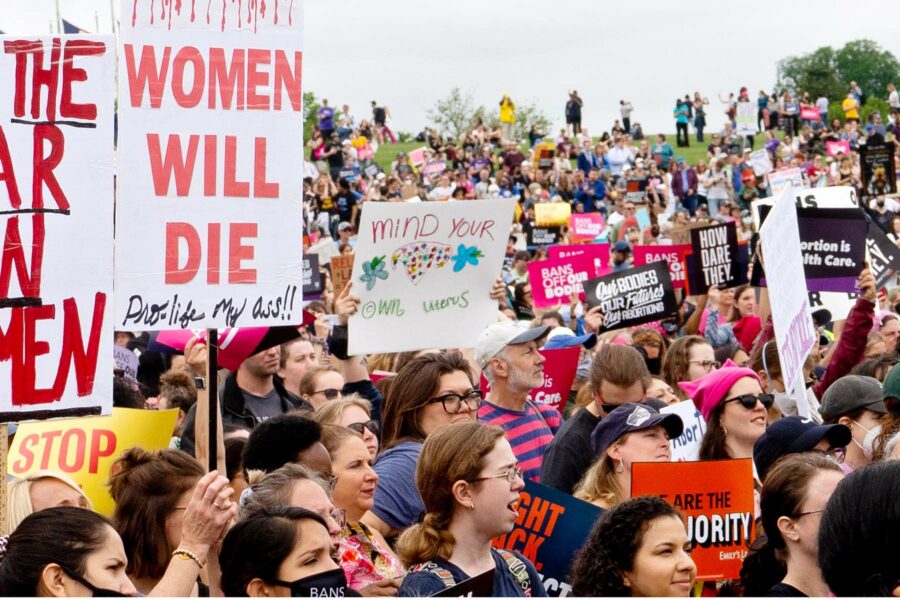
Campaigns to remove reproductive rights from women will prevent their full participation in society and the economy. Without women’s freedom to choose how and when to have children, there cannot be gender equality

Ensure healthy lives and promote well-being for all at all ages
By 2030, reduce the global maternal mortality ratio to less than 70 per 100,000 live births
Maternal mortality ratio
Proportion of births attended by skilled health personnel
By 2030, end preventable deaths of newborns and children under 5 years of age, with all countries aiming to reduce neonatal mortality to at least as low as 12 per 1,000 live births and under-5 mortality to at least as low as 25 per 1,000 live births
Under-5 mortality rate
Neonatal mortality rate
By 2030, end the epidemics of AIDS, tuberculosis, malaria and neglected tropical diseases and combat hepatitis, water-borne diseases and other communicable diseases
Number of new HIV infections per 1,000 uninfected population, by sex, age and key populations
Tuberculosis incidence per 100,000 population
Malaria incidence per 1,000 population
Hepatitis B incidence per 100,000 population
Number of people requiring interventions against neglected tropical diseases
By 2030, reduce by one third premature mortality from non-communicable diseases through prevention and treatment and promote mental health and well-being
Mortality rate attributed to cardiovascular disease, cancer, diabetes or chronic respiratory disease
Suicide mortality rate
Strengthen the prevention and treatment of substance abuse, including narcotic drug abuse and harmful use of alcohol
Coverage of treatment interventions (pharmacological, psychosocial and rehabilitation and aftercare services) for substance use disorders
Alcohol per capita consumption (aged 15 years and older) within a calendar year in litres of pure alcohol
By 2020, halve the number of global deaths and injuries from road traffic accidents
Death rate due to road traffic injuries
By 2030, ensure universal access to sexual and reproductive health-care services, including for family planning, information and education, and the integration of reproductive health into national strategies and programmes
Proportion of women of reproductive age (aged 15–49 years) who have their need for family planning satisfied with modern methods
Adolescent birth rate (aged 10–14 years; aged 15–19 years) per 1,000 women in that age group
Achieve universal health coverage, including financial risk protection, access to quality essential health-care services and access to safe, effective, quality and affordable essential medicines and vaccines for all
Coverage of essential health services
Proportion of population with large household expenditures on health as a share of total household expenditure or income
By 2030, substantially reduce the number of deaths and illnesses from hazardous chemicals and air, water and soil pollution and contamination
Mortality rate attributed to household and ambient air pollution
Mortality rate attributed to unsafe water, unsafe sanitation and lack of hygiene (exposure to unsafe Water, Sanitation and Hygiene for All (WASH) services)
Mortality rate attributed to unintentional poisoning
Strengthen the implementation of the World Health Organization Framework Convention on Tobacco Control in all countries, as appropriate
Age-standardized prevalence of current tobacco use among persons aged 15 years and older
Support the research and development of vaccines and medicines for the communicable and non-communicable diseases that primarily affect developing countries, provide access to affordable essential medicines and vaccines, in accordance with the Doha Declaration on the TRIPS Agreement and Public Health, which affirms the right of developing countries to use to the full the provisions in the Agreement on Trade Related Aspects of Intellectual Property Rights regarding flexibilities to protect public health, and, in particular, provide access to medicines for all
Proportion of the target population covered by all vaccines included in their national programme
Total net official development assistance to medical research and basic health sectors
Proportion of health facilities that have a core set of relevant essential medicines available and affordable on a sustainable basis
Substantially increase health financing and the recruitment, development, training and retention of the health workforce in developing countries, especially in least developed countries and small island developing States
Health worker density and distribution
Strengthen the capacity of all countries, in particular developing countries, for early warning, risk reduction and management of national and global health risks
International Health Regulations (IHR) capacity and health emergency preparedness
Percentage of bloodstream infections due to selected antimicrobial-resistant organisms
Campaigns to remove reproductive rights from women will prevent their full participation in society and the economy. Without women’s freedom to choose how and when to have children, there cannot be gender equality
Climate — Global
Even the most optimistic predictions show a significantly warmer planet by 2100. Rather than focusing on quick adaptive fixes, as many current plans do, countries must pursue climate-resilient development strategies that address the systemic nature of the climate crisis
Gender — Global
If progress on empowering women and girls was already far too slow, COVID and the war in Ukraine have made entrenched gender inequalities even worse. We must urgently ramp up our support for women and girls across all spheres of development, or the SDGs are doomed to fail
Climate — Global
Humanity’s failure to learn and adapt from repeated crises does not bode well for the bold, transformational changes that must happen urgently if we’re to achieve the world promised by the SDGs. There will be no second chance
Economic development — Global
COVID has exacerbated already deep inequalities between rich and poor.
If left unchecked, the forces creating inequality will become even more
destructive as the climate crisis starts to bite, threatening all of Agenda 2030. The world must urgently redouble efforts to reverse these trends
Pandemic recovery — Global
The pandemic was the ultimate stress-test for the global health system, revealing both flaws and capabilities. We must build this new knowledge into health systems if we’re to achieve good health and well-being for all
Climate — Global
Air pollution is killing an estimated seven million people per year, causing environmental damage and climate change. Taking bold action now on black carbon, methane, and other short-lived pollutants, using existing, affordable technologies, can help us achieve 1.5°C and improve well-being for all
Financing — Global, Sub-Saharan Africa
Global development finance has been thrown into disarray – first by the pandemic and now the war in Ukraine. Ramping up finance flows to LDCs in the short term might appear unrealistic, but it is more essential than ever if we’re to avoid even greater catastrophes ahead
Global governance
Recent years have seen the G20 become more factional, with countries competing for national advantage. Indonesia, holder of the G20 presidency for 2022, intends to rally the member countries to deliver a unified, coordinated response to global challenges: a G20 for the SDGs
The experience of COVID has fundamentally changed our understanding of country risks. These lessons need to shape and drive COP26