
Beyond domestic emissions: the need for consumption-based climate mitigation
Critics of the UN Framework Convention on Climate Change’s focus on production-based emissions argue that it ignores “carbon leakage.” How might a consumption-based approach, looking beyond national borders, improve climate mitigation strategies?
Climate — Global

Author

Grayson Fuller
Senior Manager, SDG Index, Data, and Statistics, Sustainable Development Solutions Network (SDSN)
In the lead-up to COP28, the conclusions of the first global stocktake show that the world is far off track for limiting warming to 1.5°C. More ambitious mitigation measures and targets will be essential. Specifically, phasing out all unabated use of fossil fuels and scaling up renewables will be (to quote the authors of the global stocktake’s technical dialogue) “indispensable elements of just energy transitions to net-zero emissions.”
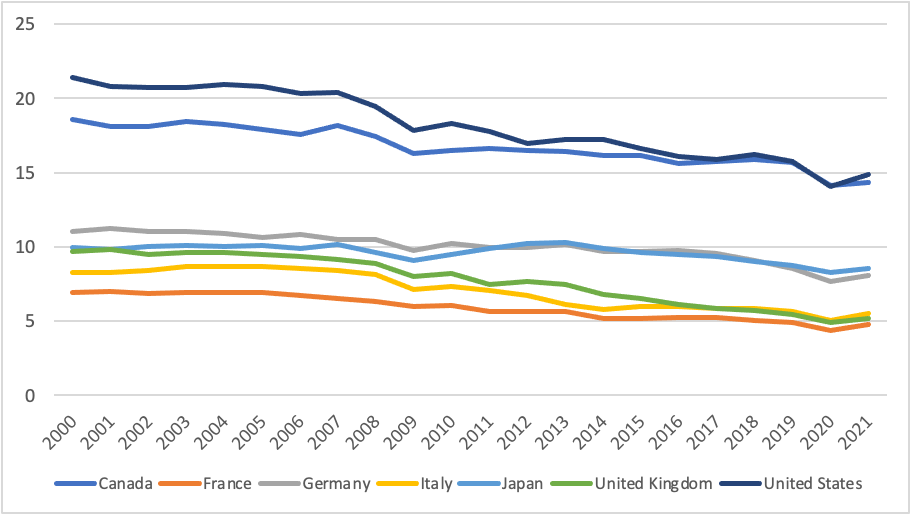
Countries have used a variety of tools to reduce their emissions, including carbon taxes, cap-and-trade systems, energy efficiency standards, subsidies for renewable energy, and renewable portfolio standards. By using different mixes of these policies, all G7 countries have reduced – by varying degrees – their per capita CO2 emissions from fossil fuels since the turn of the century (Figure 1). Of course, the current rates of emissions reduction in these countries need to accelerate. However, these emissions reductions do not capture the entire picture, since not all emissions generated by countries happen within their borders.
Figure 1: Decline in CO2 emissions (tonnes/capita) from fossil-fuel combustion and cement production in G7 countries
Source: Friedlingstein, et al., Global Carbon Budget 2022
Supply or demand?
In a globalized world where trade consists of international production processes, it is essential to quantify the emissions that a country’s consumption generates beyond its borders. Those offshore impacts, referred to as externalities or “spillovers,” are now measured with the consumption-based accounting (CBA) approach. In short, production-based accounting measures all impacts that happen within a country’s borders, which a government can address with local supply-side measures. Conversely, CBA measures all impacts associated with a country’s consumers, be they domestic or international. CBA is therefore useful for identifying the appropriate demand-side interventions, particularly by adjusting consumption patterns.
Using CBA to measure and monitor spillover effects is important to ensure countries do not simply offshore their emissions to other countries. Take the example of Greece in Figure 2. While domestic greenhouse gas (GHG) emissions have decreased since 2016, emissions happening overseas to satisfy Greek consumption have risen and are projected to potentially overtake domestic emissions based on the latest growth rates (see figure note). In Switzerland, by contrast, the GHG emissions generated domestically are already very low but are far outnumbered by the country’s upstream emissions occurring abroad (Figure 3). This underscores the need for countries to monitor both their domestic and offshore emissions.
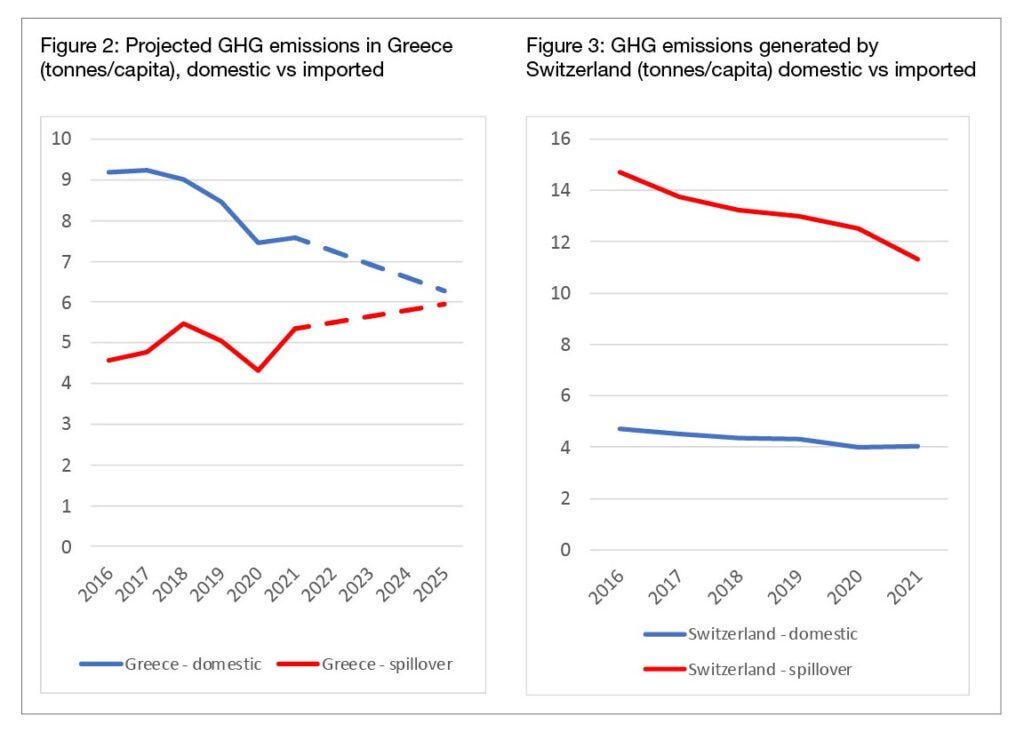
Source: Release 057 of the GLORIA global environmentally extended multi-region input-output (MRIO) database (Lenzen et al. 2022), constructed in the Global MRIO Lab (Lenzen et al. 2017).
Figure 2 note: projections to 2025 are based on linear annual average growth rate from 2016 to 2021. The dip in 2020 is from the contraction in demand from the COVID-19 pandemic.
Curbing offshore emissions
In addition to monitoring their overseas emissions, there are several policy options for countries to curb their offshore emissions:
- target-setting
- supply chain regulation
- trade regulation
- cross-border carbon pricing
Target-setting
Rich countries in particular should consider consumption-based targets and monitoring systems to track the emissions and other environmental impacts from their consumption beyond national borders. Last year, Sweden announced its intention to become the first country to integrate imported CO2 emissions within its national climate targets. These targets can be downscaled to firms as well: the Science Based Targets initiative (SBTi) provides research and guidance to companies aiming to reduce their GHG emissions in a way that is consistent with the goals of the Paris Agreement.
Supply chain regulation and due diligence
National governments can curb overseas emissions by requiring businesses to do due diligence on their suppliers. Due diligence legislation often includes clauses to ensure that overseas suppliers are respecting human rights, paying workers a fair wage, and producing goods in an environmentally sustainable way. These laws, adopted so far in only a handful of countries, mostly apply to large companies and can provide sanctions and penalties for countries that fail to comply.
Although many of these due diligence laws cover social issues, such as child labor, modern slavery, occupational safety, or the right of association and unionization, they can also include environmental standards, including emissions, deforestation, and pollution. While legislation is important for due diligence requirements, so too is enforcement. France, for example, introduced its corporate duty of vigilance law in 2016. Yet there are cases of large French companies not doing any reporting whatsoever and others where businesses are flagrantly violating the law.
Trade regulation
As trade agreements govern the rules of imports and exports between trading partners, they can be an important tool for countries and regional blocs to manage their overseas emissions. There are an increasing number of environmental and sustainability provisions integrated into international trade agreements.
In the case of the EU, since 2011, all modern EU trade agreements contain chapters on trade and sustainability. These chapters notably contain clauses requiring the effective implementation of international conventions on environmental and labor standards. At the international level, there are initiatives for reform of the World Trade Organization (WTO), which will be discussed at the WTO’s next ministerial conference in February 2024. The ‘Remaking the Global Trading System for a Sustainable Future’ project recently published its recommendations for WTO members, including a net-zero emissions target in international trade.
Carbon pricing and carbon border adjustment mechanisms
In many countries, carbon trading schemes establish a cap and a price on carbon emissions. These incentivize companies to emit less by increasing their production costs. However, if not all countries have the same carbon price, businesses may be incentivized to offshore production to countries where the absence of climate mitigation legislation allows for cutting these costs. The widespread adoption of adequate carbon pricing mechanisms globally would prevent this so-called “carbon leakage.”
In the absence of an internationally adopted carbon price, the EU has introduced the Carbon Border Adjustment Mechanism (CBAM). It works by extending a carbon price to goods that are manufactured abroad and then imported into the EU. However, there are valid concerns that CBAM is protectionist and puts an additional burden on developing countries that are the least responsible historically for climate change.
Cooperation not contention
CBA and the offshoring of GHG emissions calls for scrutinizing our current system of international trade and global value chains. International trade can be a powerful source of growth and social prosperity for developing countries, but sustainability criteria and legislation are key to make sure it happens in a way that is consistent with the goals of the Paris Agreement. Net-zero targets and strategies need to account for global supply chains and do so in a way that encourages cooperation – not contention – between the Global North and South.
Featured in:

Climate Action edition 2023: Taking stock
COP28 will be responding to the first Global Stocktake – a comprehensive assessment of our progress towards the goals of the Paris Agreement. That progress is too slow and, as our prospects of keeping within the 1.5°C target slip away, the emphasis shifts from mitigation to adaptation. With it, the focus moves to the Global South, which will suffer the worst impacts and lacks the resources to adapt. Climate justice and ‘loss and damage’ will take center stage.
This edition presents a range of actionable approaches to mitigate and adapt to climate change. The solutions offered are framed in the context of the SDGs and delivering climate justice.
Authors include Helena Viñes Fiestas, Tim Clairs, Phoebe Koundouri, Cassie Flynn, Olufunso Somorin, Maria Outters, Simonetta Cheli, Ibrahim Thiaw, Yamide Dagnet and Vanessa Ushie.
Publication date: 29 November 2023

Related articles

Stop treating finance as the last step in adaptation
Too often, adaptation finance is treated as an exercise that begins only once a plan is finished. Building investment planning into resilience strategies from the start is key to turning plans on paper into bankable projects on the ground
In the Sahel, peace starts with water
A shrinking Lake Chad and increasingly erratic rains are pushing herders and farmers in the Sahel into conflict over water and land. Lasting peace depends on securing indigenous land rights, strengthening cross-border cooperation, and putting climate finance directly in local hands

Global urban goals: who asked the planners?
SDG 11, the New Urban Agenda and the International Guidelines on Urban and Territorial Planning all rely on planners to put them into practice. Yet no one has conducted a representative survey of planners, asking whether these frameworks have changed their work, or whether the planning laws they work under even allow what the frameworks call for