
Stopping polarization from destroying democracy
Political polarization is pushing many democracies into mutually hostile camps with conflicting views of reality. Restoring democratic health will require citizens and leaders to shift the focus from what divides society to what binds it
Peace and security — Global
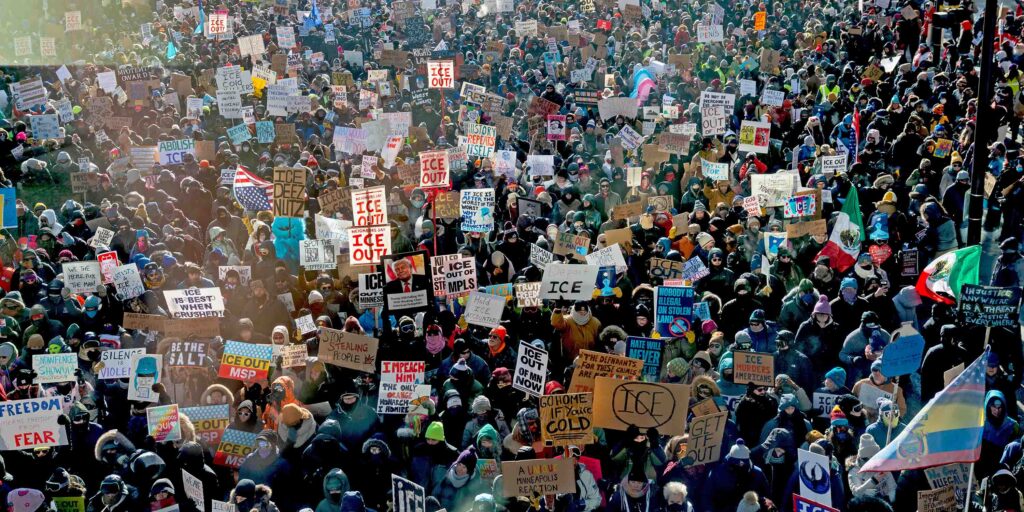

The Swedish institute Varieties of Democracy (V-Dem) has just published its annual Democracy Report 2026, titled “Unraveling the Democratic Era?” Its indices show that nearly twice as many countries are now experiencing democratic decline as those that are improving, and that there are now more autocracies than democracies. Freedom of expression is the dimension of democracy hardest hit.
This deterioration is also reflected in the limited progress recorded in the 2024 and 2025 Sustainable Development Goal (SDG) reports, especially in SDG 16 on peace, justice, and strong institutions. Particularly concerning are indicators showing stagnation or backsliding on press freedom, access to justice, and corruption and organized crime. These reflect the broader deterioration in protections for individual freedom, civil liberties, and equality documented by V-Dem. They also show how weakened accountability mechanisms are no longer preventing abuse of state power, illicit enrichment, and the concentration of power in unchecked executives.
Exacerbating the problem is the rise of “us versus them” polarization, in which society gradually divides into two antagonistic political blocs. The V-Dem report indicates that political polarization has been rising globally since 2005. Research I conducted with Murat Somer and Russell Luke on pernicious polarization, autocratization, and opposition strategies shows that high levels of this kind of polarization are associated with democratic erosion. We describe it as “pernicious polarization” because of its harmful effects on democracy.
In pernicious polarization, ideological disagreements often are transformed into identity-based conflicts, in which compromise comes to feel psychologically threatening. People begin to view issues and policies in win–lose terms, divide the world into a virtuous in-group and an evil or immoral out-group, and see the opposing political camp as an existential threat to their way of life or the nation as a whole. In the extreme, political violence may result.
Such political divides inhibit the ability of a society and its elected representatives to solve intractable problems. Communication breaks down among citizens and between representatives of opposing political blocs. Compromise is seen as a sell-out of one’s values and moral principles. Some of the SDGs themselves turn into faultlines of polarization, such as gender equality and protection of the climate and biodiversity.
Competing views of reality are exacerbated by the fragmentation of information, the “post-truth” era of politics, and the rhetoric of ambitious politicians seeking to exploit this context by fueling “us versus them” conflict.
How democracies can depolarize
The solution is to shift the focus from what divides to what binds a society:
- shared identities, such as love of country
- shared values and interests, such as a desire for one’s children to thrive in conditions of safety, freedom, and equality
In a forthcoming book with Murat Somer, we propose several strategies to depolarize, beginning with the following two to help a society re-find a sense of common purpose and restore the health of democracy.
First, policies and mechanisms to help restore cross-cutting ties – relationships and forms of belonging that connect people across social and political divides – are necessary to rebuild trust in fellow citizens and in democratic institutions. For example, creating or strengthening local spaces where citizens can deliberate and solve local problems together can empower them to participate in collective problem-solving rather than withdraw into isolation and alienation. Technology also creates new opportunities to involve larger numbers of citizens and to scale up such participation to regional or national deliberations. It can also provide a channel for input into representative bodies charged with collective decision-making.
Second, shifting both perspectives and outcomes from win–lose to win–win can help to depolarize. In pernicious polarization, identities and interests intersect as people judge economic or social policies in terms of who they believe deserves to benefit. They may see such policies as unfairly benefiting an “undeserving” group – immigrants, a racial or ethnic minority, or another gender – especially when polarizing politicians have blamed those groups, without evidence, for their supporters’ grievances.
One win–win solution to this problem was proposed by a group of scholars at the University of California, Berkeley. “Targeted universalism” offers an alternative to the contentious binary between policies directed at specific disadvantaged groups and universal policies intended to benefit society as a whole. It argues that policies should focus on universal goals for the entire population and then devise targeted strategies based on the different needs of specific groups. For example, improving the quality of medical care may require different strategies for different groups: rural populations may lack transportation and nearby hospitals, while racial minorities or women may receive inferior care or less attention in medical research because of physician bias or entrenched misconceptions.
Who can reverse pernicious polarization
Who will instigate and implement the shift in perspective, policies, and systems change required to overcome pernicious polarization and renew democracy? Pernicious polarization is the product of conscious political choices – and it can be overcome through human agency as well. The demonizing language and exclusionary policies utilized by polarizing politicians is an intentional strategy to win and keep power by dividing electorates. To overcome it will require multiple stakeholders:
- Visionary and courageous political leaders will be required to mobilize citizens and bring new ideas to fruition.
- Intellectuals, policy experts, and civic groups can create new ideas giving rise to new institutions and policies that will address the fundamental dilemmas of contemporary democracies and serve their countries better.
- Business, labor, media, and technology leaders and organizations can support efforts to turn the fault lines of polarization into opportunities for problem-solving.
- Movement builders can provide organization and a compelling narrative to create non-partisan or cross-partisan campaigns needed for democratic reform.
- Ordinary citizens can push politicians and political parties to depolarize by resisting perniciously polarizing appeals and demanding solutions to collective problems. They can help regenerate cross-cutting ties and shared values in their local communities. And they can dissent and resist when polarizers and those who erode democracy threaten the collective wellbeing.
Democratic disagreement need not destroy democracy. But preserving it will require citizens and leaders alike to reject pernicious polarization and rebuild the shared purpose, trust, and institutions on which democratic life depends.
Related articles

Removing restrictive gender norms through education
Education can be a powerful force for shifting unequal gender norms, but schools do not transform them automatically. Embedding gender equality in education systems at scale – and defending that work against growing backlash – requires sustained political commitment, institutional reform, and public support
The hidden toll of maternal malnutrition in conflict settings
Conflict and displacement are driving a largely overlooked crisis in maternal nutrition, with grave consequences for women, babies, and long-term development. Protecting mothers’ health is one of the most effective ways to save lives and advance progress across the SDGs in fragile settings
Can the UN still make peace?
With the Security Council divided and the UN’s wider credibility under strain, member states are looking to the next Secretary-General for a fresh vision of peacemaking. But what can one leader realistically do to restore the organization’s influence on peace and security?