
Removing restrictive gender norms through education
Education can be a powerful force for shifting unequal gender norms, but schools do not transform them automatically. Embedding gender equality in education systems at scale – and defending that work against growing backlash – requires sustained political commitment, institutional reform, and public support
Gender — Global
Author

Rachel Marcus
Senior Research Fellow, Gender Equality and Social Inclusion, ODI Global
“There is nothing more transformative and irreversible than education. There is no public policy, there is no court ruling, there is no law, there is no government that is more transformative than education. So, if you hinder education with a gender focus, you are hindering the advancement of the rights of these historically marginalized groups.” (NGO founder and gender expert, quoted in ALiGN’s report on teacher training and gender equity in Colombia.)
At its best, education has unique potential to transform unequal and discriminatory gender norms. One of its key purposes is to open minds to new knowledge and ideas. It is largely provided at a life stage when learning is most rapid, and when children and young people are intensely socialized into the gender norms deemed appropriate in their societies – by family, peers, teachers, and others.
As rates of participation in primary and secondary education have risen over recent decades, so has the promise of education as a powerful tool for transforming gender norms at a scale and depth hard to match by approaches such as media campaigns or legal change. That said, 273 million children and young people worldwide remain out-of-school. That number reminds us that transforming gender norms through education requires focused attention to extending access to children missing out, and to establishing lifelong learning opportunities.
A wealth of evidence has established the relationship between education for both girls and boys – particularly secondary or post-secondary education – and social wellbeing outcomes, such as enhanced public health and reduced child marriage. But at the same time, schools often reinforce dominant gender norms, as much through the “hidden curriculum” – the values and norms that are transmitted through everyday practices – as through the formal curriculum.
For example, teachers’ expectations can lead to young people being channeled into certain areas of study based on their gender. Alongside gender norms in wider society, this contributes to the under-representation of women in science – in fields such as scientific research (where globally women account for 31% of researchers) and engineering(where globally women constitute 28% of graduates). Likewise, men are under-represented in fields such as education (where women make up 85% of pre-primary teachers) and healthcare (where women constitute 67% of the global health workforce, though only 25% of leaders). Additionally, students’ policing of one another’s compliance with stereotypical gender norms can lead to sexist and homophobic bullying, both in person and on social media.
Embedding gender equality into school curricula and practices
Exposure to new information and ways of thinking, and to people with different perspectives – both teachers and peers – can open horizons and lead to shifts in students’ attitudes, values, and behavior. It can build self-confidence, aspirations, and determination – key dimensions of empowerment. This can occur even without dedicated curriculum content on gender equality, as students are exposed to scientific, historical, or other information that challenges gender preconceptions. This empowering potential is far more likely to be realized where education is high quality – as Sustainable Development Goal (SDG) 4 emphasizes – and when children’s rights to freedom from hunger (SDG 2), good health (SDG 3), clean water (SDG 6), and safety (SDG 16) are also met.
However, and as recognized in SDG Target 4.7 (knowledge and skills for sustainable development), a growing body of evidence suggests there is added value in an intentional focus on nurturing gender-equitable values through education. Initiatives dedicated to doing so have blossomed worldwide in recent years. Though hugely diverse in scope and scale (from one-day workshops to multi-year embedded curricula), effective initiatives typically:
- deploy student-centered pedagogies and encourage students to think critically about gender norms in their families and communities (including at school)
- inspire students to identify ways they can challenge unequal norms and practice – for example, intervening if they witness sexual harassment, or advocating for fairer divisions of labor within the household. In doing so they can help students move beyond changes to individual attitudes to more collective, societal change
- back up in-class initiatives with outreach to families and a whole school approach – this involves:
- building a vision and ethos that emphasizes all students flourishing
- “auditing” a school’s procedures and practices to make sure they promote fairness and equality
- training all staff (not just teachers) to be able to reinforce these values
Though few initiatives are evaluated, evidence from India shows they can have a lasting effect on attitudes. For example, a two-year life skills course for 12 to 14-year-olds in the public education system of India’s Haryana state led to a 16 percentage point increase in support for gender equality among participants, which persisted for at least two years after the end of the course.
Transforming education systems at scale requires action on curricula and learning materials, as well as embedding content on teaching for gender equality in teacher education. An ODI Global study on nurturing gender-equitable masculinities found that successful scale-up of new curricula and learning resources often requires compromise so that content can be fitted into existing curriculum frameworks. Designing learning materials so they can easily be adapted to diverse local contexts is also essential. Additionally, effective scale-up often requires a staged roll-out that takes into account lessons from initial implementation. Key actions at different levels of an education system are summarized in the diagram below.
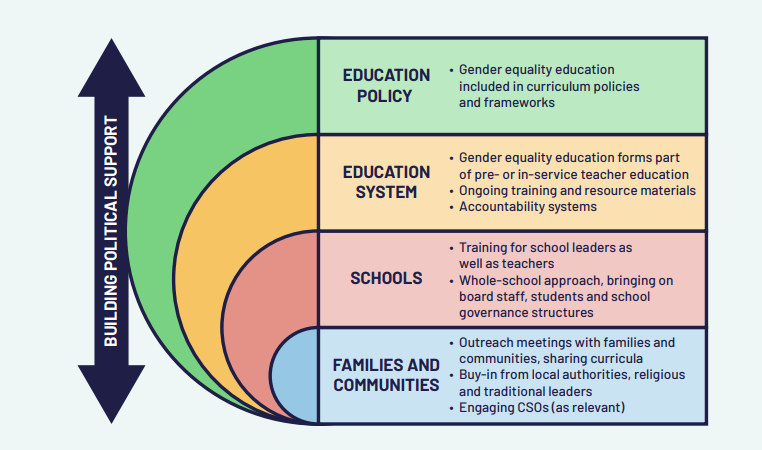
Source: Marcus et al (2024), Nurturing gender-equitable masculinities: lessons for transforming norms through education systems, ALiGN/ODI Global, London
Challenges – and strategies for overcoming them
Although education has strong potential to positively influence gender norms, it also faces significant challenges. Recent global surveys suggest declining support for gender equality among young men. This may be driven by misogynistic online content producers targeting boys and men who feel economically, socially, or politically disenfranchised, and who blame women or feminism for their situation.
Related narratives contest the idea that schools should play a role in nurturing support for gender equality. Longstanding resistance to schools teaching gender-related content has been mobilized by increasingly organized and widespread political campaigns. These sometimes include threats to teachers who encourage students to think critically about gender or racial inequalities, or school administrations that explicitly promote human rights-based values. Such campaigns also target both national political processes and international norm-setting bodies, seeking to end support for subjects like life skills or sex and relationships education where content on gender equality is often taught. These campaigns are well-funded, supported by dominant media ecosystems, and often misrepresent actual or proposed policies (see ODI Global’s note on norm-spoiling at the UN).
Investing in critical digital and media literacy skills for both young people and adults is a key “social inoculation” strategy – a way of building resilience to counter gendered and other forms of disinformation. It should be embedded in school education as well as lifelong learning and adult literacy programs. This is especially critical in an era when AI deepfakes can be generated instantaneously and are amplified by algorithms designed to spread polarizing material. Community-level outreach that shows what children are actually learning in relation to contentious issues can help dispel rumors and deliberate misinformation.
Conclusion
Realizing education’s potential to help create a more gender-equal world requires investment in extending quality educational opportunities, both formal and non-formal, for all children and adults. It also means strengthening the inclusion of gender equality, human-rights-based teaching, and critical digital skills at all stages of education.
As the forces that seek to roll back gender equality and human rights gather political momentum, mobilizing the political will and resources to invest in the transformative power of education has never been more critical.
Related articles
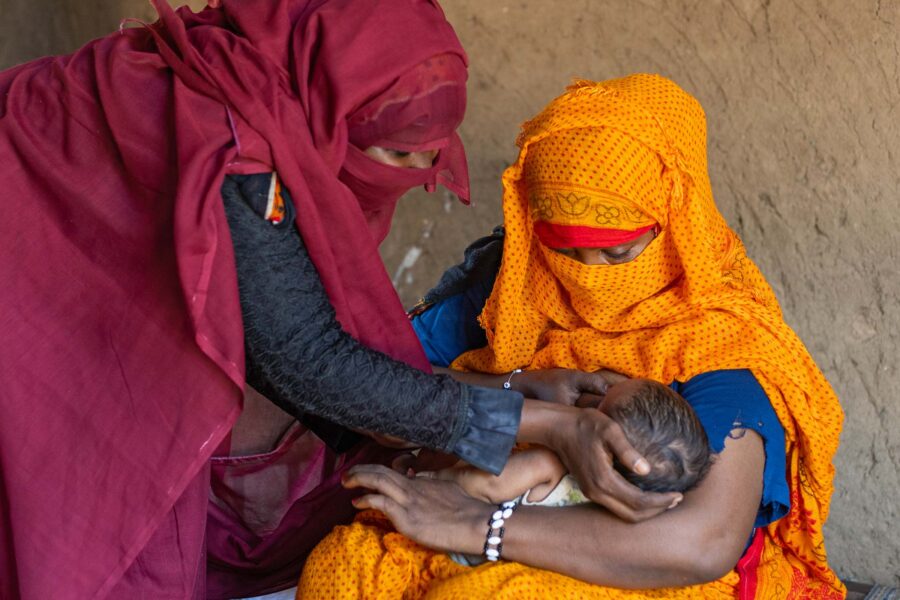
The hidden toll of maternal malnutrition in conflict settings
Conflict and displacement are driving a largely overlooked crisis in maternal nutrition, with grave consequences for women, babies, and long-term development. Protecting mothers’ health is one of the most effective ways to save lives and advance progress across the SDGs in fragile settings
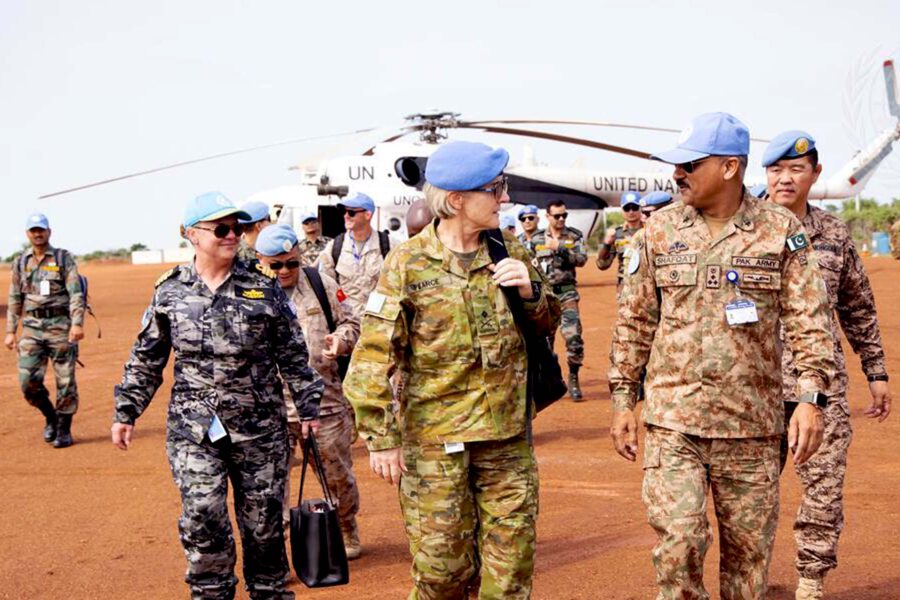
Why the UN needs women’s leadership
The case for a woman Secretary-General is not just about symbolism. More representative leadership would strengthen the UN’s legitimacy, improve decision-making, and better equip the institution for an era of compounding global crises